
All posts by admin

Time in the Market vs Timing the Market: What Every First-Time Investor Should Know

When it comes to property investing, there’s one phrase every new investor eventually hears: “It’s not about timing the market, it’s about time in the market.”

It sounds simple, but it’s one of the hardest lessons for first-time investors to truly understand. The truth is, Australia’s property market doesn’t move in a straight line. It rises, it dips, it pauses, and those who try to pick the “perfect” moment often end up watching from the sidelines.

At Buyer Insight, we’ve seen this story unfold too many times. Buyers who wait for prices to fall or interest rates to change often miss the very windows where opportunity lies. Meanwhile, those who buy strategically, hold long-term, and let time do its work they’re the ones who build real wealth.

Let’s understand what exactly time in the market means, why timing the market is so risky, and then we’ll look at what intelligent investors actually do instead. 

Understanding the property cycle

The Australian property market moves in cycles rather than linear movements along a trajectory. Each cycle typically has four main phases: 

  1. Recovery – when prices level out after a downturn, and confidence begins to return slowly.
  2. Upswing – when demand from buyers increases, listings tighten, and prices start to increase.
  3. Boom – when momentum builds and the peak of growth is met, along with an irrational fear of missing out on media amplified surges in short-term price growth.
  4. Correction – when growth slows, or prices stay flat, as affordability and demand normalise.

Each phase offers opportunities, but they’re not always obvious when you’re in the middle of them. That’s why experienced investors focus less on predicting the cycle and more on positioning themselves within it.

You can learn more about how we help investors navigate these cycles on our Investors page, where we outline the process of researching markets and identifying sustainable growth areas. 

Why “timing the market” rarely works

Trying to time the market perfectly — waiting for the lowest point or aiming to sell at the absolute top — sounds great in theory. But in practice, it’s almost impossible.

Here’s why:

  • Cycles vary by location. Sydney, Brisbane and Adelaide can all move differently. While one dips, another may be rising.
  • External factors change quickly. Interest rates, migration, supply, and policy shifts all move the goalposts.
  • Sentiment drives momentum. By the time the headlines say “the market is booming,” much of the growth has already happened.

The result? Most people end up doing the opposite of what they planned, buying when everyone else is, and hesitating when the best opportunities appear.

At Buyer Insight, we see timing attempts as short-term noise. Long-term investing, backed by data and fundamentals, beats guessing games every time.

Time in the market: how real wealth is created

Owning the right property for a long enough period is what drives serious wealth creation.

That’s because of two forces:

  1. Capital growth compounds over time. Even modest 4–6% annual growth adds up significantly across 10–20 years.
  2. Leverage multiplies results. When you use borrowed funds, growth applies to the entire property value — not just your deposit.

Let’s say you buy a $700,000 investment with a $140,000 deposit. If it grows 5% a year, that’s $35,000 in equity annually, or roughly 25% return on your deposit each year, before rent or tax benefits are even factored in.

It’s not flashy or overnight, but it’s how everyday professionals quietly build seven-figure wealth.

What long-term investors do differently

Here’s what the most successful property investors in Australia have in common:

  • They buy quality assets early and hold them long.
  • They focus on fundamentals — location, demand, infrastructure, and scarcity — not hype.
  • They review, not react. Market dips are seen as holding opportunities, not exit triggers.
  • They partner with professionals — buyer’s agents, brokers, and planners who help them stay strategic.

What first-time investors should remember

If you’re just starting your investing journey, remember these key property investment tips:

  1. Start when you can, not when you think the market is “perfect.”
    The right time is when you have your finances, goals and guidance aligned — not when a headline says “buy now.”
  2. Buy the right property, not the loudest one.
    A well-located, high-demand area with strong rental yields will outperform flashy new builds or speculative suburbs.
  3. Let time do the heavy lifting.
    The first few years may feel slow, but equity growth accelerates as the market compounds and debt reduces.
  4. Keep perspective.
    Over 10–15 years, short-term fluctuations fade. What remains is the quality of your asset and your consistency in holding it.

How to stay confident through market cycles

Market headlines can be emotional. When prices dip, fear rises; when they boom, excitement takes over. The trick is to separate noise from numbers.

Property investing isn’t about getting rich next year — it’s about setting yourself up for freedom in 10 or 20 years’ time.

By being mindful of time in the market, intelligent purchasing decisions, steadfast holding and reviewing your approach, you will benefit from the market’s innate cycles that reward patience and thoughtfulness. 

At Buyer Insight, we can help you do just that; you’ll have a clear property investment strategy, you’ll be buying strategically and remain invested with confidence through every market turn. If you also want to deepen your understanding of finance and investments, reach out to us anytime. You can either call us at 0468 444 478 or book a free consultation here.

Start now. Because in property, it’s not timing the market that matters; it’s time in the market that changes everything.


Property Investment Strategy for Professionals: Turning Income into Long-Term Wealth

Most professionals spend years building a career, working long hours, and earning a solid income, yet many still find their money sitting idle in the bank. The truth is, income alone doesn’t create wealth. Smart investing does.

That’s why more and more professionals across Australia are turning to property investment, not just to grow their wealth, but to create real financial freedom for the years ahead.

At Buyer Insight, we work with doctors, lawyers, engineers, IT specialists and other busy professionals who want to invest, but don’t have the time to research markets, inspect properties or negotiate deals. The goal is simple: to turn today’s income into tomorrow’s long-term wealth, with the right strategy behind every purchase.

Why professionals are well-placed to invest

Most professionals already have what many investors don’t: a stable income, strong borrowing power, and the discipline to plan for the future. These are huge advantages.

But high income can also create comfort. Many people delay investing because they’re “too busy right now” or think they’ll start later. Unfortunately, time in the market is just as important as timing the market. The earlier you start, the more you gain from growth and compounding.

That’s where having a clear property investment strategy makes a difference.

If you’re new to investing, professional help can literally rebuild your empire. It outlines how we shape strategy, reduce risk, and grow portfolios with clear steps. 

Building a strategy that actually works

When we work with clients at Buyer Insight, we break it down into three parts:

1. Growth first, emotion later

People are programmed to gravitate toward neighbourhoods they already know and like, or shiny new developments. But smart investing is not about decoration, it’s about data. We care about population growth, future infrastructure, job creation and rental demand. These are all indicators of capital growth, not just convenience. 

2. Balance the numbers

Investment doesn’t just rest on what the property is worth; it also carries a cost to hold.  We want to help clients identify properties where rental income services the loan comfortably, so cash flow remains healthy regardless of whether rates go up. It’s not just about the investment, but peace of mind. 

3. Structure and tax efficiency

How you buy can matter as much as what you’re buying. The correct structure, personal name, trust, and/or SMSF will establish a tax position and returns in the future. We encourage clients to work with their accountant/planner to get this part right. 

Mistakes many professionals make

We see the same few errors over and over again:

  • Buying with emotion instead of evidence.

  • Waiting too long for the “perfect” market.

  • Stretching too far on repayments.

  • Following trends instead of a tailored plan.

The cost of getting it wrong can set you back years. That’s why having a buyer’s agent for professionals changes the game, someone who lives and breathes the market, runs the numbers for you, and keeps you focused on strategy, not stress.


Why a buyer’s agent makes sense for professionals

Think about how much time you put into your own work. You wouldn’t expect someone outside your field to do what you do without training. Property is no different.

Our role at Buyer Insight is to handle the heavy lifting: research, inspections, due diligence, negotiation, and even helping you structure your finance. We work only for the buyer, not the seller, so our advice stays completely independent and focused on your goals.

You stay focused on your career, while we help build your property portfolio quietly in the background.


Real-world example

One of our clients, a Sydney-based engineer, came to us unsure where to start. He had equity in his home but no time to look for investments. We helped him buy a property in Brisbane’s north-west, an area with new transport upgrades and low vacancy rates.

Fast forward five years, that property’s value is up more than 40%. The rental income now covers the loan, and he’s planning his next purchase. That’s what a clear, data-backed strategy can do.

How to get started

If you’re a professional thinking about property, here’s a simple roadmap:

  1. Clarify your goals. Know why you’re investing — growth, income, or retirement planning.

  2. Understand your numbers. Talk to a broker or adviser about your borrowing power.

  3. Get expert guidance. Work with a buyer’s agent who understands the professional mindset and can find investment-grade properties.

  4. Take action. The market rewards those who start — not those who wait.

Turning income into wealth starts with one move

You’ve worked hard to build your career. You can now put your money to work for you at least as hard as you work to earn it. By using the right property investment approach, you can grow your wealth, safeguard your income, and achieve genuine financial independence. 

At Buyer Insight, we help professionals make confident, informed decisions through research, negotiation skills, and comprehensive support.

If you are also one of those who want to invest in property but are confused about the process and perfect strategy, reach us anytime. You can call us freely on 0468 444 478 or book a free consultation with our experts as well. Let’s build your long-term wealth, one smart property at a time can change your future.

Underquoting at Auction: How Buyers’ Agents Level the Playing Field

Real estate price “baiting” where agents list a property below its true value, is still common in Australia. A recent ABC News investigation found multiple Sydney auctions where homes sold 15–31% over their advertised guides. Homeowners described attending these auctions as “demoralising” and “exhausting” when the final price was well beyond their budget. In other words, lowball price guides can lure large crowds and spark bidding wars – a practice ABC calls “price baiting”, which unfairly inflates competition and leaves buyers paying more.

Source 

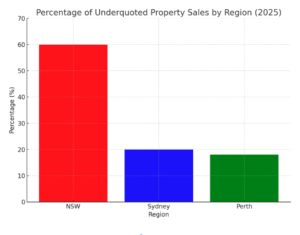
Across the country, underquoting is a widespread issue. Buyer research tools (like KoalaData, now Homer) tracked 220+ listings in 2025 with price guides more than 10% below the final sale price. Nearly 60% of those misleading guides were in New South Wales, but Sydney and Perth are also hotspots (about 20% and 18% of sales, respectively). Major media reports note that even with laws against bait advertising, underquoting remains common in Sydney and Melbourne auctions. In Queensland, agents can’t even give a guide price for auctions at all, showing how seriously states take the problem.

As buyers’ agents, our job is to protect clients from these traps. We start by doing our own homework: checking recent comparable sales, property histories and market data instead of trusting the listed guide. For example, Sydney buyer’s agent Frank Russo told ABC News it’s “highly misleading” and “unethical” for agents to quote low when they know sellers expect much more. We take that to heart by running the numbers on every property. If a listing looks too cheap, we dig deeper. We might open a buying strategy: often, we can approach the seller or the selling agent privately and make a direct offer before auction day, potentially saving our client from an emotional bidding war.

How buyer’s agents protect you:

  • Research local data: We use tools like KoalaData and CoreLogic to verify a property’s true market value, not just the advertised guide. (Industry experts say buyers assume underquoting is common – it’s wise to expect that and double-check.)

  • Set a clear budget: With a realistic bid range in mind, we help you stick to it. Entering the auction with a firm upper limit (or negotiating outside of the auction) means you won’t get swept up in a “gotta win” frenzy.

  • Auction strategy: We’ll often preview auctions or attend similar ones to gauge competition. In many cases, we can make a buyer-agent offer directly, saving time and avoiding auctions that are likely out of reach.

  • Leverage transparency: In states like Victoria, agents must now justify their price guides with three recent comparable sales. A buyer’s agent can review those comps and the listing’s “statement of information” to spot any red flags of underquoting.

Regulators are cracking down, too. NSW Fair Trading has launched an $8.4 million taskforce on price baiting, and agents caught underquoting face fines (up to $22,000), loss of commission or license. Consumer Affairs Victoria reports thousands of underquoting complaints: since 2022, its taskforce issued 203 fines (totalling $2.3 million) and hundreds of warnings to agents. (Even if laws vary by state, the trend is clear: buyers need accurate price guides and stronger consumer protection.)

In practice, we advise all buyers – first-home or investors – to treat suspiciously low guides with caution. Verify price ranges by comparing recent sales in that suburb. If a guide seems unrealistically low, ask why: sometimes agents re-post a higher range right after auction, as happened in Burwood (after a 28% overshoot, the guide was later raised by $1 million). Ultimately, engaging a buyer’s agent means you have a professional looking out for your interests. We do the legwork and negotiation so you don’t waste weekends chasing auctions beyond reach.

Ready to bid with confidence? At Buyer Insight, we guide both first-home buyers and investors through every step. We’ll help you set a realistic budget, explore finance options, and connect you with expert buyer’s agents who know the data and the market. Protect your purchase with professional advice – speak to our team today about buying smarter. Call us on 0468 444 478 or book a free 30-minute consultation to get started.

Australia’s Property Market 2025: Why Property Remains the Most Reliable Wealth-Building Tool

Even though interest rates have gone up, Australia’s housing market is still strong. There aren’t enough homes for the number of people looking to buy, and the population is growing fast. Home values across the country have jumped about 39% over the past five years.

Experts think prices will keep rising slowly; KPMG expects them to go up around 3.3% in 2025. After a short pause, prices are climbing again. If inflation keeps falling, the Reserve Bank may start cutting rates late next year, which would boost buyer confidence and keep the market growing.

Australia’s rental market also remains tight, with low vacancy rates pushing rents up sharply. Over the past five years, rents jumped ≈42.7% nationally, providing investors with solid yields. In this environment, property continues to outperform many other assets for long‑term investors.

Why Property is a Wealth-Building Asset

Property ownership has been a consistently strong long-term investment in Australia. CoreLogic and historical data show that Australian home values have grown on average 6–7% per year over decades. For example, a median-priced home bought in 1991 (≈$123k) would be worth ~$795k by 2021. Even recent years saw record growth – the typical dwelling in 2025 is roughly 6.5–8 times household income, double what it was in 2001. In short, long-term capital gains have been exceptional, far outpacing inflation or wage rises. As one analyst notes, “Many Australians have built substantial wealth and secured their financial futures by making smart property investment decisions”.

Strategic Buying: How a Buyer’s Agent Helps

Buying the right property is just as important as owning it. A buyer’s agent acts on your behalf to find the best options for homes to build wealth in your future and to save you time and money. At Buyer’s Insight, our team has local market knowledge and builds knowledge that provides our clients with an edge:

  • Data-Driven Location Choice: We search for suburbs that have the most growth potential. To illustrate, we look for areas that are about to receive new withholding infrastructure, transport connectivity, good schools and employment centres. Investing in these ‘strategic locations’ provides an advantage in excess of the average capital growth.

  • In-Depth Due Diligence: We inspect every property we consider in a thorough fashion. Due to our prior experience in the construction industry, we are able to identify hidden defects or future defects (easements, flooding or zoning restrictions) that others may not know to look for. By identifying risks upfront, we can give our clients peace of mind and ensure they have made a quality investment.

  • Negotiation & Off-Market Access: With years of experience, we negotiate strongly to secure lower purchase prices. We also tap our network to find off-market listings (homes not advertised publicly) – giving clients early access to great deals that ordinary buyers never see.

  • Tailored Strategy: Everyone’s goals are different. We work closely with each buyer to set a clear strategy (first home, upsize, investment) and stick to it. We avoid emotional bidding wars and focus on value – for instance, seeking properties with scope for improvement (dual-income, granny flat potential) or simply great rental prospects.

  • Saving Time and Stress: Searching hundreds of suburbs and listings is a full-time job. A buyer’s agent filters out poor fits and only recommends properties that truly match your needs and budget. You avoid wasted inspections and indecision, and can trust that we’re always working for your best outcome.

In our experience, this strategic approach makes a big difference. By combining buyer-side insights with the latest market data and on-the-ground intel, we ensure our clients are positioned to profit when the market rises again. As one review puts it, Buyer’s Insight “knows what to look for and what to avoid” before purchase, so clients can buy with confidence.

Building Wealth with Property: Key Takeaways

  • Think Long Term: Property is not a get-rich-quick scheme, but over 5–10+ years it has reliably built equity for owners. Past decades of data show compounding gains.

  • Start Early: Start Early: It’s always better to begin sooner rather than later. The earlier you buy a property, the more time your investment has to grow in value. Even a small first property can help you build equity, which you can use later to upgrade to a bigger or better home.

  • Focus on Fundamentals: Rent growth, population, and supply-demand are what really drive value. Properties in locations with job growth and a limited amount of land available (city fringe and rapidly growing areas) tend to achieve the best capital growth.

  • Use Professional Help: A buyer’s agent like Buyer’s Insight can speed your path to wealth. We handle research, negotiation, and paperwork so you capture more upside.

Many Australians who follow this smart, disciplined buying approach end up with significantly more wealth than those who try to “time the market” or guess. It’s why property remains the most trusted wealth-builder in our economy.

Ready to Invest with Confidence?

If you’re ready to make property work for your future, Buyer’s Insight is here to help. We are a specialist buyer’s agent dedicated to your long-term success. Contact us today at +61 468 444 478 or book a free consultation to start the conversation. With expert guidance and a clear strategy, your dream home or investment can be the foundation of real wealth and Buyer’s Insight will help you get there.

Land Value Still Leads in Property Growth: Key to Better Home Returns

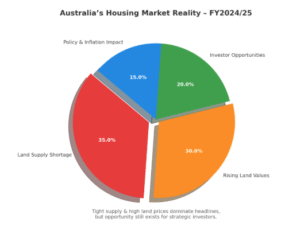
Recent data from the Housing Industry Association (HIA) confirms what many buyers are experiencing on the ground: land prices are surging. In FY2024/25, the national median lot price surged by 6.8%, which was three times faster than inflation. This stark price increase has made land costs the main hurdle in achieving Australia’s 1.2 million homes target, an issue becoming increasingly visible in the property market.

Source 

At Buyer Insight, we are seeing this trend play out with clients, both first-home buyers and investors alike. The low supply of land, combined with rising values, presents a real challenge but also new opportunities for those with a plan.

Key Markets are Tightening Fast 

  • Land prices up sharply. The demand for land-connected options has consistently been higher than the available supply. As a result of this imbalance of consistent demand, the prices for land connected options increased by 6.8% last year. This growth in land price far outpaces general inflation, ensuring that blocks remain expensive.
  • Key markets are tightening. Perth lot prices soared by about +30% over 12 months. Brisbane’s lots jumped 9.2%, pushing it past Melbourne for the first time in years. Even Adelaide (usually cheaper) saw typical lot values rise by ~8%. Western Australia, South Australia and Queensland have had more available land (and faster building), but their price advantage is now shrinking. 
  • Costs remain high. The cumulative build cost increase is around +33% since COVID. And despite recent rate cuts, new home approvals and starts are still 7–9% below long-term averages. In other words, cheaper finance hasn’t fixed the land crunch – builders need more ready land even as borrowing costs ease.

Why Land-Linked Homes Outperform 

Rising land prices translate into bigger gains for detached homes. A house comes with a block of land, so it participates in land-driven growth, whereas apartments do not. As finance experts note, “houses usually offer greater long-term capital growth than apartments” because land typically appreciates. In a tight market, that land component really matters: owners of standalone homes should see stronger capital gains.

For first-home buyers and investors today, the message is clear: act early while land is still available. With interest rates fairly stable and no quick fix for supply, now is an ideal window to lock in ground-floor value. Each small rate cut only boosts demand further, so securing a home now can avoid chasing even higher prices later. Well-chosen standalone homes should outperform units as scarce land values keep climbing.

Another factor that increases the stability of land-linked properties is the limited supply of developable land in major urban centres. As the population is increasing and the planning process takes longer, land becomes harder to purchase and increasingly more expensive. This is a consistent and continuous upward pressure on prices for houses that have their own land. Therefore, new apartment buildings, which can be built more easily, typically increase in value at a relatively lower rate over time. 

For more guidance and insights, you should partner with professionals like Buyer Insight. If you have questions or are ready to start your search, feel free to call us at +61 4684 4478. You can also book a one-on-one consultation today to get more personalised advice.

Why Successful Buyers Use a Buyer’s Agent – And Why You Should Too

whybuyers should use

Presented by Buyer Insight – Strategic Property Buying with Integrity

Exclusively on Your Side

We act solely in your best interest – no one else’s. Just as sellers have an agent representing them, so should buyers. At Buyer Insight, we’re your advocate, ensuring every decision is based on your goals.

Data-Led Strategy & Expertise

Buying a property isn’t just about finding a house – it’s about securing the right asset. We design and execute a tailored strategy using cutting-edge research and market insights to maximise outcomes and minimise risk.

Education Through Action

We don’t just transact – we educate. You’ll gain clarity and confidence through our transparent process, learning exactly how the property market works while we handle the heavy lifting.

Access Beyond the Public Market

Over 30% of the best properties are sold before they’re advertised. We tap into off-market and premarket deals via our network, giving you a competitive edge and avoiding costly bidding wars.

Elite-Level Negotiation

Our negotiation experience – in both private sales and auctions – protects you from overpaying. We leverage data, tactics, and market insight to deliver the best possible price and terms.

Real-Time Market Intelligence

Where should you buy? What’s the growth outlook? We provide sharp, strategic guidance based on your goals, not guesswork, helping you invest wisely and confidently.

Comprehensive Due Diligence

From title searches and easements to flood risk, zoning, rental performance and resale prospects – we interrogate every deal to ensure you have full visibility and zero surprises.

Save Time. Reduce Stress.

You don’t need to waste weekends inspecting subpar properties. We filter, inspect, assess, and present only the best-fit options, with detailed feedback and walk-throughs – all delivered straight to you.

Trusted Network of Experts

We connect you with our vetted, professional network: mortgage brokers, solicitors, inspectors, property managers, accountants and more – all aligned to support your purchase journey.

A Long-Term Property Partner

Our support doesn’t end at settlement. As your lifelong property partner, we remain available to guide you through your next purchase, sale, or investment decision – whenever you need us.

The Rise of Granny Flats as a Smart Investment Opportunity

Unlock Value in Your Own Backyard

As property prices continue to climb and pressure on housing grows, more buyers and homeowners are turning to granny flats as a smart way to boost value. These compact second dwellings are no longer just for elderly parents-they’re becoming a serious strategy for rental income, flexibility, and long-term capital growth.

Why More Buyers Are Building Granny Flats

Reliable Rental Income

A well-designed granny flat can provide a steady income stream-whether you rent it to long-term tenants, students, or for short stays. In the right area, this can ease mortgage repayments or create additional cash flow.

Tax Benefits

When used to generate income, granny flats may offer potential tax deductions on expenses such as interest, maintenance and depreciation. Always seek independent tax advice to ensure you’re structured correctly.

CGT Relief for Family Arrangements

For those housing elderly parents or family members with disabilities, formal family arrangements may offer capital gains tax relief. It’s important to seek professional legal and financial advice to understand eligibility.

Boost to Property Value

Adding a granny flat often increases a property’s overall appeal and resale value. Buyers see the flexibility-whether it’s for extended family, future rental income, or even downsizing later on.

What You Should Know Before Building

Regulations Vary

Planning rules differ across states and councils. Many regions have relaxed their policies, but lot size, design, and approval processes still apply. It’s essential to speak with your local council or a qualified consultant before starting any build.

Funding Options

Granny flats can often be funded through home equity, personal savings, or a construction loan. The right approach depends on your financial position and long-term goals.

Know Your Purpose

Are you building to rent, house family, or increase resale value? Your goal should shape the design, layout, and fit-out.

Check Local Rental Demand

Do your homework. Consider vacancy rates, average rent, and who your potential tenants might be. This will help you set realistic expectations and avoid costly surprises.

Plan for the Future

Granny flats are more than a short-term solution. They’re a future-focused investment that offers versatility, strong returns, and added value. Done right, they can turn unused land into a high-performing asset.

At Buyer Insight, we help homeowners and investors make smart, strategic property decisionsgranny flats included. From understanding local rules to rental strategy, we guide you every
step of the way.

Smart investing starts with the right insight-welcome to Buyer Insight.

What are the costs involved when buying a property?

Some costs are more obvious than others, so in this guide we outline the costs that could come up along the process of buying a property. These are estimates however so you will need to do your own due diligence.

The reason we put this guide together was because if you know about these costs, you can plan ahead and not get a surprise if you are required to pay for some of them, which in most cases you will.

Finance

Generally your broker will be paid via a commission arrangement with the bank, however if your situation is complex, or you after strategies and plans, a broker might choose to charge you a service fee.

Lender mortgage insurance (LMI) – LMI is an insurance policy that protects the lender in the case that the borrower cannot repay the loan. It’s generally for those with less than a 20% deposit. It shouldn’t be looked at as a bad thing, as it helps you get into the property sooner and really should be looked at as a tool. The amount will depend on the amount you are borrowing and your deposit, so chat to your broker about this.

Loan application – some banks might charge a loan application fee for processing the loan. These can start at $150.

Valuation – The bank can charge you for a valuation on the property, however, this cannot be more than what the bank is paying for it.

Discharge of mortgage fee – Some lenders and loan products could attract an exit fee if you wish to pay off your loan earlier or close the loan. Always check with your lender or broker to understand these costs.

Break fee – This is specific to a fixed rate home loan and is a fee the bank will charge you because you have broken the agreed length of time that you would keep the loan. The break fee amount will depend on the loan size, the rate and at what time you are wanting to exit.

Ongoing account fee – Offset accounts, and other more flexible loan types might have account maintenance fees that the bank charges monthly or yearly.

Switching fees – A fee for refinancing with the same lender but switching to a different loan.

Settlement fee – This can be charged two times, first when you settle the property and then another settlement fee is charged if you ever decide to refinance your loan with another lender.

Government Charges

These are fees and charges that the government charge over and above anything else, and most buyers are unaware that the transfer fee and mortgage registration is something that the government charges.

Stamp duty in NSW is calculated on a sliding scale according to your property value. A standard transfer duty rate applies to residential properties up to $1,168,000 but below $3 million. There’s a premium duty rate for properties worth over $3 million. Generally, first-home buyers of properties valued under $1 million pay a reduced stamp duty rate in New South Wales.

Stamp duty costs in NSW will vary depending on: The property’s value, The type of property you purchase (e.g. house, vacant land, off-the-plan), Your residency status, Your eligibility as a first-home buyer, Your eligibility for pensioner concessions

See SRO calculator for more information

Transfer fee (state based) $171.70 for NSW (May 2025)

Mortgage registration $171.70

Legal/Conveyancer

One of the most important team members will be your solicitor/conveyancer as they will handle the settlement and check over contracts before you sign your life away, so its crucial not to be price driven when selecting representation. Depending on the complexities of the purchase, costs are $800-$3000.

Example $1100 for conveyancer + $800 for disbursements

  • Disbursements – these are over and above the standard legal fees
  • Title search
  • Local council information
  • Road authorities reports
  • Utility authorities certificates
  • Administrative expenses such as photocopying mailing and printing
  • Attending the settlement
  • Obtaining strata reports

Building and pest inspector

Depending on the size of the home, and if you require both the building and pest inspections completed.

Cost $400-$2000 (always allow a kitty for B&P as this is very important)

building and pest inspector

Home, building and contents insurance

A commonly missed cost is your insurance, but they are very important and should be arranged well before settlement so you are covered from day 1. It’s best to shop around on these and use some of the comparison sites out there.

The average cost in NSW is approx. $1500 for home and contents.

Rates and fees reimbursement to vendor

The vendor might have paid the rates for the rest of the year or quarter. You will need to reimburse the vendor for the remaining time left, but don’t worry, your conveyancer or solicitor will work out the amounts.

These can be in the form of council rates, water rates and strata fees.

Moving costs

Costs to move can range anywhere between a few hundred dollars if you and your mates are going to hire a truck and move yourself which is the most common option for the first few moves. But if you have done it a few times and know the pain, there are white glove services which literally move everything for you. In the morning you leave the old house and in the evening you drive to the new property where everything has been moved and unpacked for you. The dream.

Cost $100-$5000

Connecting utilities gas, water, electricity and internet

The connections to your services will depend on who you go through and there are plenty of comparison websites available to do some shopping around. Also, check with the provider if you need to have everything turned off at the mains in order for them to connect.

Allow $300-$600 here.

Re-establishment survey

Not a very common one, but a re-establishment survey should be completed if you are unsure on the boundaries of a property. Generally when buying a property, there will be some way of identifying what is your property and what is not, usually a fence or a peg. If you cannot properly identify the boundary, or you believe it to be different when compared to the plan of sub division (see contracts and sec 32’s), you can order a re-establishment survey to have these boundaries defined.

Cost $850 – $1900

So what can you expect?

In the below examples we have put together a table of costs when purchasing a $750,000 exisiting property for both a first home buyer and non FHB.

$750,000 purchase in NSW (non FHB)

Stamp Duty $28,279.00
Mortgage Registration Fee $171.70
Transfer Fee $171.70
Title Search Fee $17.60
Building and Pest $800
Legal or Conveyancing Fee $1,400
Connections $400
Moving $500
Total Fees and Charges $31,740.00

$750,000 purchase in NSW FIRST HOME BUYER

Stamp Duty $0
Mortgage Registration Fee $171.70
Transfer Fee $171.70
Title Search Fee $17.60
Building and Pest $800
Legal or Conveyancing Fee $1,400
Connections $400
Moving $500
Total Fees and Charges $3,461.00

Interest Rates Are Down: Here’s How Smart Buyers Are Taking Advantage

The Reserve Bank of Australia recently cut interest rates, creating one of the most compelling opportunities for home buyers and property investors in years. But here’s the catch—this advantage won’t last long.

Lower interest rates mean more affordable mortgages, greater borrowing power, and ultimately, a chance to secure your ideal property for less. But there’s a flipside: more competition.

So how do you turn this situation into a winning scenario?

Here’s What Savvy Buyers Are Doing Right Now:

Getting Clear on Finances:  Smart buyers are recalculating their budgets and borrowing capacity immediately. Knowing exactly what you can afford places you ahead of the competition.

Targeting Strategic Opportunities : They’re not just looking everywhere; they’re pinpointing growth suburbs and emerging markets where properties offer value today and growth tomorrow.

Leveraging Negotiation Skills: In a competitive market, having a skilled negotiator in your corner can be the difference between a good deal and a missed opportunity. Savvy buyers ensure they’re represented effectively.

Streamlining Their Property Search: Time is critical in a hot market. Smart buyers streamline the property search to view only quality options that meet precise criteria, saving valuable time and energy.

Planning for Long-Term Success: Interest rate cuts provide short-term relief, but real success comes from strategic, long-term planning—thinking beyond today’s savings to future wealth creation.

At Buyer Insight, we guide our clients through each step of this strategic approach. Our goal isn’t just to help you buy property—it’s to help you build lasting wealth and security.

Ready to act decisively?

Connect with us and discover how you can leverage the current market conditions to your advantage.

What Every Smart Buyer Should Know About the 2025 Property Market Think Ahead – Buy Smart

In 2025, the property game is shifting fast. Limited housing supply, new mortgage options, and smart government schemes are reshaping the way Australians are buying property. Whether you’re entering the market or expanding a portfolio, knowing the landscape is key.

Key Trends to Watch

Limited Quality Listings on the Market: While properties are available, truly investment-grade or first-home-worthy options are limited—making it crucial to act quickly and with expert advice.

  • Creative Lending Options: Banks are introducing longer-term interest-only loans, offering breathing room in the short term, but requiring smart long-term planning.
  • Government Support is Strong: Programs like the First Home Guarantee and Help to Buy make homeownership more accessible than ever.
  • Infrastructure Projects Creating Hotspots: Major transport and infrastructure upgrades are transforming outer suburbs into investment hotspots, attracting buyers chasing long-term growth potential.

Takeaway

The market is competitive, but the tools to win are in your hands—if you move strategically. Get expert guidance, do your due diligence, and step in with confidence.