
Australia’s Housing Market Outlook for 2026: Price Forecast & Trends

The future of the housing market in Australia in 2026: Housing market to where?

The Australian property market has continued to be a vital source of household wealth and economic confidence for the country going forward to 2026. Following market momentum created in 2024 and 2025, 2026 is now to be another determining year for buyers and investors in the Australian real estate market, and here they face a supply crunch, affordability issues and changing demand trends.

The new findings of Cotality in their annual report of Decoding 2026 show that 87% of industry participants expect dwelling values to rise appreciate in the year to come, and very few respondents predict a decline in prices. This is indicative of general optimism in the Australian housing market outlook 2026.

Buyer Insight presents a comprehensive property market forecast for 2026 in this article, including the property price and regional trends, as well as the key aspects defining the choice of Australian property investors.

2025 Momentum Carrying into 2026

The national dwelling values rose sharply in 2025, with the December Home Value Index by CoreLogic indicating an 8.6% growth in housing values at the national level of about $71,400 to the median home price.

This performance identifies two key sources of Australian housing market growth

  • Unrelenting shortages of housing supply – new construction has not kept up with population growth.
  • strong buyer demand – fuelled by migration, employment stability and rental pressure.

These factors contributed towards keeping confidence in the property price outlook Australia, notwithstanding increasing costs of living and the difficulty with borrowing.

National Price Forecasts for 2026

Several industry reports reveal that 2026 will bring additional growth in prices but the rate will differ in different regions and dwelling types.

According to the KPMG Residential Property Market Outlook, national house prices will increase by up to 7.7% in the year 2026, and unit prices will also grow by an average of 7.1%.

This is a balanced housing market forecast for Australia 2026, which represents:

  • High housing demand and high housing supply
  • Long-term housing shortages
  • Continued government subsidies for first-home buyers
  • Changing investor and owner-occupier behaviour

This combination is the reason why the trends in the Australian property market 2026 have steady momentum.

City-Level Insight: Where Growth Is Expected

The performance of the market in 2026 is going to be highly diverse in capital cities, which supports the necessity of location-specific analysis of property investment Australia.

  • Perth is projected to record the highest growth nationally, with annual price increases forecast between 12-13% Given by population growth and economic expansion. For investors seeking guidance, working with a buyers agnet perth can give investors who are looking for advice strategic insight into suburbs that are performing well.
  • Brisbane and Darwin are also expected to experience a high growth of over 10% and will be aided by the relatively low cost.
  • Adelaide will experience relatively average growth of mid-single digits; this implies that the market fundamentals are improving.
  • Sydney and Melbourne are likely to experience slower growth of about 5-7%, which is due to high entry prices and loan limits.

This difference indicates the importance of professional market analysis in the assessment of the best cities to invest in property Australia 2026.

              Affordability and Market Drivers for 2026

Affordability is also one of the largest issues that is informing the Australian housing market outlook. Shifts in the cash rate of the Reserve Bank of Australia and the tightening of the lending conditions have lowered the borrowing capacities of most buyers.

In spite of this, the demand is robust because of:

  • Stable employment levels
  • Gradual wage growth
  • Continued migration
  • Lack of housing opportunities

As a result, most buyers are considering outer-suburban and regional expansion areas in pursuit of enhanced values in the property affordability Australia model.

The initiatives by the government, like the disseminated 5% Deposit Scheme, are also contributing to the growth of competition between eligibility price lines.

Rental market Trends and investment signals

The demand and supply in the rental markets are believed to be tight in the year 2026, which will further boost the property investors in Australia. High occupancy rates and the lack of supply have raised the rent to record-high levels in most areas.

Favourable rental terms have sustained real estate that has the potential to become a good rental yield. Thus, income-earning assets remain appealing in diversified investment portfolios.

This economic climate supports more strategic thinking to invest in the best real estate investment in Australia, to balance between capital expansion and long-term cash flow.

Risk and Headwinds: What Buyers Should Watch

Though the overall market mood is optimistic, there are a number of risks that might affect the trend in property prices Australia:

  • Affordability pressures may limit buyer capacity in premium suburbs. 
  • Interest rate uncertainty remains a major economic variable.
  • Regional market divergence may create uneven performance outcomes.

These risks are important to understand in case professionals are interested in long-term property investment strategies.

What This Means for Australian Buyers and Investors

The Australian property market outlook 2026 is an indicator of a strong but picky market. Key implications include the following:

  • Continued national house prices growth supported by fundamentals
  • Increased regional/outer-metro market significance.
  • Strong rental market keeping investor confidence
  • Growing professional requirements of professional data-driven decision-making

To buyers and investors, a mix of trustworthy market research with individualised recommendations is still the key to successful navigation in property market trends.

Conclusions: Navigation 2026 with Insight and Strategy

The housing market in Australia in 2026 is both a chance and a challenge. Although the national forecasts suggest constant growth and strengths of the rental, regional variations and affordability issues demand planning.

Whether you are in the market as a first-time buyer or you are looking to add to your investment portfolio, knowing where property prices are headed next will help you make decisions that will be future-orientated.

Keep in touch with Buyer Insight to keep up with what is going on in the market and to get the comments of experts.

Follow us on Instagram.

Follow us on Facebook.

Connect on LinkedIn.

Contact on: 61 468 444 478

Are you ready to build your property strategy? Get a free consultation with our professional team and get a personal plan on achieving your 2026 property goals.

Australia Housing 2026: Growth Slows to 5% After 8–9% Run

A Slower, Steady Market Ahead: What Buyers Should Know

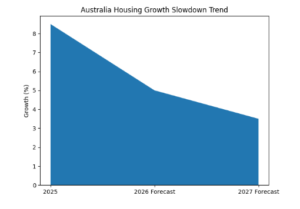
Australia’s housing market had a roaring 2025; national prices jumped roughly 8–9%, but forecasts now point to a cooler outlook. Major banks (CBA, ANZ, NAB, Westpac) expect national growth to slow to about 5% in 2026 and around 3–4% in 2027. Importantly, no capital city is expected to see outright price falls over the next two years. Instead, conditions will vary by city: Perth and Brisbane have been the hottest markets recently, while Sydney and Melbourne show signs of topping out. Borrowing costs have risen (with RBA rate hikes in Feb 2026 and expected in May), and affordability is very tight (the national median home is now over 8× the average income). These headwinds will drag on price growth

Source 

Big Banks Diverge on City Outlooks

The CBA and Westpac agree on the broad slowdown, but differ on which cities win. CBA sees Perth and Brisbane continuing double-digit growth in 2026 (about +15% and +12%), driven by “strong market momentum, tight supply-demand balance, and robust local economies”. However, even CBA expects that boom to fade; by end‑2027 Perth and Brisbane would slow to ~4% growth. In contrast, Westpac is more cautious: it forecasts only ~7–8% growth in 2026 for those cities, noting that stretched affordability will curb demand even with very low vacancies.

For Sydney and Melbourne, both banks see much softer outcomes. CBA expects just ~2% growth in Sydney and ~1% in Melbourne in 2026, rising to only ~3–2% by 2027. High prices mean many Sydney buyers are “priced out”, few households can afford a $1.6M home, and even Melbourne’s rebound is “nuanced” despite its lower base. Westpac similarly predicts Sydney will be “flat in real terms” (around 3% nominal) and Melbourne only 4–6% in 2027. In practice, affordable suburbs and middle-ring areas in these cities are outperforming while the most expensive pockets cool.

What This Means for Buyers and Investors

Mid-sized capitals remain opportunities. Perth and Brisbane still have momentum thanks to very low supply. Perth listings are ~40% below normal, and Brisbane is similarly tight, keeping competition fierce. That supports rents (great for investors) and means price growth will continue in 2026, albeit at a slower pace. If you missed out on the first surge, there’s still room to grow, but remember growth won’t be double-digit forever. By 2027, more buildings and a settling population growth (post-COVID migration) should ease pressure.

Affordability shapes your plan. With homes now costing ~8 times average income, even a low rate rise sharply cuts borrowing power. Budget carefully: factor in the RBA’s recent and expected hikes, and use tools like our Borrowing Capacity Calculator to see how much you can afford. Also, remember helpful schemes: the First Home Guarantee (5% deposit) and other grants are supporting lower-priced segments.

Long-term demand is still intact. Population and incomes aren’t collapsing. Australia is still growing, just more slowly. Employment is solid, and migration will rise again. Meanwhile, housing supply is only now catching up after years of under-building. In other words, we still need more homes. If you’re patient, slower growth means you won’t miss a steep upswing, and prices aren’t expected to crash. It’s a time to pick your entry point carefully, consider value-growth suburbs and lock in current rates before any further rises.

Ready to act on these insights? At Buyer Insight, we help first-home buyers and investors understand how market trends and policies affect them. We can walk through your new borrowing power, loan choices, and scheme eligibility in simple terms. Call us on 61 468 444 478 or book a free 30-minute consultation to get tailored advice. Follow us on Instagram and connect on LinkedIn for more property market updates and tips.

Australia Housing Prices Up 9.9% in 2026: What Buyers Face

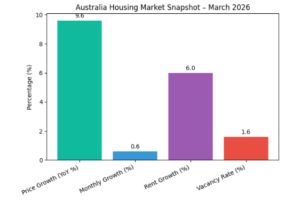
The latest NAB Housing Monitor is out, and honestly, it tells a story that every buyer and investor in Australia needs to sit with for a moment. Australian Capital City Housing Prices Up 9.6% in 2026. In February alone, values climbed another 0.6%. That’s not a blip. That’s a market that simply hasn’t stopped moving.

Source 

Where’s the growth coming from?

The cities doing the heavy lifting right now are Perth, Brisbane, and Darwin. These markets have been running hot, driven by strong population growth, tight rental supply, and a consistent gap between demand and what’s actually available to buy.

Sydney and Melbourne? Growth is still there, but it’s slowing. After years of outperforming, both cities are feeling the weight of affordability limits. That’s not a bad thing; it’s actually an opportunity. Investors who’ve been sitting on the fence in those markets may find pockets worth revisiting.

Nationally, the average dwelling value is sitting around $900,000. Let that sink in.

The Rental Story and Why it Matters for Buyers

Vacancy rates are hovering near 1.6%, and advertised rents are growing around 6% annually. That’s a landlord’s market, full stop. For anyone looking at property as an investment, a tight vacancy means strong yield potential, provided you’re buying in the right suburb.

This is exactly where buyers make the most costly mistake: chasing headline numbers without understanding the local dynamic. A 1.6% national vacancy rate doesn’t mean every suburb is performing equally.

The supply problem isn’t going away

Here’s what concerns me most in this report: housing supply growth remains weak. Construction labour shortages are slowing builds. And while there’s a large pipeline of homes under construction on paper, delays are real, and they’re pushing delivery timelines out further than expected.

What does that mean for buyers? It simply indicates less stock, more competition and most importantly, higher prices. The fundamentals for growth are still firmly in place for well-selected properties.

This is why strategic property selection matters more than ever. Buying something just to “get into the market” without proper due diligence can cost you not just financially, but in years of underperformance.

The market is rewarding buyers who are prepared. Pre-approval sorted, suburbs shortlisted, strategy clear. Those who are reactive, waiting for prices to drop or for “the right time,” are watching their purchasing power shrink each month.

If you’re a first home buyer or an investor looking to build or expand a portfolio, now is the time to have a real conversation about your position, not later.

Ready to move with confidence? At Buyer Insight, we work with both first home buyers and investors to cut through the noise and make smart decisions. Whether you’re figuring out where to start or looking for your next investment hotspot, let’s talk. Call us at Buyer Insight on +61 468 444 478 or book a free 30-minute consultation without any pressure or clarity.

Follow us on Instagram and connect on LinkedIn for regular market updates straight to your feed.

High-Income Borrowers and the 2026 Loan Risk

The Borrowing Power Trap: Why High-Income Buyers Still Get Caught in Bad Loans

In Australia’s fast-moving property market, it’s easy to assume that high-income earners — professionals pulling in $180,000 or more a year- are financially bulletproof. Many people will make a home purchase even with a high-paying full-time job, but most people will spend way too much to buy a property. Others who are buying homes will qualify for the mortgage payment at the time of loan approval. However, many are stuck with an expensive mortgage payment every month. Most of the time, it’s not the income that makes the payment difficult; it’s overconfidence. Yes, the price of homes and the pressure to put a deposit down quickly to beat another buyer. If you really want to buy a home smartly and have a stable home for years, understanding why even wealthy individuals get caught in this type of borrowing trap is essential.

Mortgage debt isn’t just a number on a spreadsheet. It affects budgeting, future life goals, holiday plans, retirement decisions, and, in some cases, well-being. The recent surge in mortgage lending in Australia highlights the problem. In the last three months of 2025, mortgage lending rose by about 9.5%. That shows buyers, including high-income professionals, were willing to take on bigger loans for homes and investment properties.

But this rise doesn’t sit in isolation. Inflation is still above the Reserve Bank of Australia’s target, and there’s a real chance interest rates could increase again. If that happens, borrowing will become more expensive. And that’s where the pressure builds. A loan that feels manageable today can become uncomfortable if rates rise during the loan term. What once looked affordable on paper can quickly turn into higher repayments and tighter monthly budgets. 


Why High Incomes Don’t Always Protect from Overborrowing

It may seem that somebody making over $180k has lots of cushion; however, this is just a small part of the picture. Various human and marketplace influences combine to pressure consumers into purchasing more home than they can afford. 

  1. Credit Limits Appear Like Permission
    When a lender pre-approves a large sum, it feels like a green light to borrow up to that amount, even if the real need is lower. Behavioural finance research shows that overconfidence about future earnings often leads people to take on more debt than necessary, assuming things will always go well.
  2. Emotional Decision-Making in Big Purchases
    Buying a home or investment property isn’t the same as buying a car. Emotions, desired lifestyle, children’s education, zoning/income level and projected future value all affect home loan decisions. While higher earnings provide some illusion of security, they can do nothing to change the obligation of higher monthly payments. It is due to the risk of future interest rate fluctuations or changes to individual situations.
  3. Focus on Repayments, Not Total Cost
    Many buyers focus on whether monthly repayments “fit the budget” without calculating the total lifetime interest cost. A loan that looks manageable month-to-month can become very expensive when stretched over 25–30 years, especially as interest rates adjust upward.
  4. Easily Accessible Credit Makes It Too Comfortable
    Lenders tend to price credit more favourably for higher-income borrowers and open doors that feel hard to resist. Research finds that high-income households often gain easier access to more credit with looser price schedules, which encourages overborrowing.

The Cost of Stress Beyond Money: Well-Being and Mental Health

The bank account also suffers. Higher ratios of mortgage payment to income have been shown to be a cause of greater psychological stress in many studies, even for people with high incomes. For example, research from Japan indicates that high earners have mortgage payments greater than 30% of their income. This is much more likely than those at lower ratios to indicate that they are experiencing distress. 

This phenomenon is not exclusive to Japan. However, it follows the same trend globally. The pressure that results from paying for large loans and the rising costs of everyday items hurts mental health, quality of life, and future financial peace of mind. 

Rates of Interest vs. Risk in the Marketplace 

Lending is one thing to consider when deciding to borrow; however, it also depends on what is happening in today’s economy. The Reserve Bank of Australia (RBA) suggests that it will continue to increase interest rates in order to combat continually increasing prices caused by high inflation

For high-income buyers with variable-rate loans or refinancing ahead, even modest rate increases can materially alter affordability:

  • 0.25–0.50% rate increases on significant loan amounts add thousands to annual repayments.
  • Cumulative increases over time can quickly erode discretionary income.

The Role of Smart Buyer Representation

The importance of having an experienced buyer agent to assist you is very clear here. An experienced buyer agent provides more than just a fair price negotiation. They aid the buyer in coming to a conclusion as to what they can afford to buy versus what they would like to buy. There are many important strategic elements that the buyer agent provides to assist the buyer. 

  • Objective financial lens: Helping buyers avoid the psychological allure of “borrow more, buy more.”
  • Responsible serviceability planning: Considering future rate environments, not just today’s rates.
  • Loan structure advice: Partnering with brokers or finance professionals to build sustainable debt plans.
  • Market insight: Using long-term data and trends to advise against overpaying in overheated segments.

Without this professional support, even clients with secure and high incomes might sign up for loans that inflate every minor market waver into a major personal finance headache.

Borrow With Confidence with Strategise with Buyer Insight 

High income doesn’t immunise anyone from borrowing pitfalls. If anything, it often invites overconfidence in financial planning. In an environment where property prices remain high and interest rates are no longer at rock-bottom levels, the smartest buyers are those who borrow responsibly, not just because they can.

The property market is dynamic. An approval letter isn’t enough. A pre-qualification number isn’t a strategy.

What buyers really need is clarity, someone who can step back, look at the bigger picture, and ask the right questions. What can you truly afford? How will this loan feel in two years? In five? Is this decision helping your long-term financial health, or quietly stretching you too thin? 

If you’re serious about buying wisely and avoiding the borrowing power trap, work with people who understand both the property market and your financial reality. The right guidance isn’t about pushing you to borrow more; it’s about helping you borrow smart.

For practical insights grounded in the Australian property market, follow Buyer Insight on Instagram and LinkedIn. Stay informed by booking a free consultation with us.

Australia First-Home Buyer Demand 2026

First-Home Buyers in 2026: Support Schemes vs Rising Prices

Australia’s housing market in 2026 feels a bit split down the middle. On one side, confidence is still strong. Buyers are active, and property professionals remain optimistic. On the other side, rising prices, limited housing supply, and affordability pressure are making it harder, especially for first-home buyers.

Government support schemes are helping many people get into the market. But they can only do so much. They don’t fix the bigger issue: homes are still expensive, and there simply aren’t enough of them.

Support Schemes Are Boosting Activity: But Not Fixing the Core Issue

One of the biggest influences on first-home buyer demand this year is government support, especially programs that allow buyers to enter with smaller deposits.

The expanded 5% deposit guarantee scheme (often still called the First Home Guarantee) allows eligible buyers to purchase with just a 5% deposit and avoid paying lender’s mortgage insurance. The scheme has been extended into 2026, continuing the government’s effort to help more Australians buy their first home.

And the numbers show it’s working,  at least in terms of activity.

In the final quarter of 2025:

  • First-home buyer and new owner-occupier loans increased 6.8% compared to the previous quarter.
  • The total value of those loans jumped 15.5%.
  • The average loan size reached a record $607,624, particularly in New South Wales.

These figures clearly show that support schemes are encouraging buyers to act. Agents are seeing it too. According to over three-quarters of survey respondents, there has been a rise in the number of requests for purchase following the introduction of additional 5% deposit options and benefits. However, this influx can create challenges subsequently due to increased competition within the marketplace (or network of potential purchasers). Many first-time buyers now compete with some degree of limitation on their availability for purchase. It has put upward pressure on the value and competition for ownership of a home, over what would typically occur without additional 5% deposits or incentives being made available. 

Affordability Is Still the Real Challenge

Even with government support, affordability remains a major hurdle.

Median prices across most capital cities continue to rise. And while schemes may help buyers qualify for a loan, many still struggle with:

  • Serviceability limits

  • Rising interest rates

  • Higher borrowing costs

Looking at the bigger picture, property prices in major Australian cities have grown much faster than wages over the past few decades. That gap has made home ownership harder to achieve.

Forecasts suggest prices are not slowing significantly in 2026 either. KPMG’s Residential Property Market Outlook projects national house prices to rise around 7.7% this year, even with interest rate uncertainty. Markets often seen as “more affordable,” like Darwin and Adelaide, are still expected to grow in the high single digits.

This tells us something important: support schemes help buyers get in, but they do not reduce prices. The affordability gap remains wide. And supply remains tight.

There are simply not enough entry-level homes, smaller houses, townhouses, and affordable apartments to meet demand. Listings in many areas are well below long-term averages, which keeps upward pressure on prices.

The Psychology Behind First-Home Buyer Decisions

Another important factor in 2026 is buyer psychology. There is an updated sense of urgency due to support schemes, resulting in first-home buyers feeling pressured to quickly purchase property to avoid any potential property price increases or changes to eligibility criteria. 


Support schemes are creating urgency. Many first-home buyers feel they need to act quickly before prices rise further or before eligibility rules change. This “fear of missing out” can push buyers to move faster than they should. Some may stretch financially or rush decisions without proper planning. That’s where strategic advice becomes important. Entering a competitive market without a clear financial plan can increase risk. 

What the Data Is Showing

Let’s break it down clearly:

  • Confidence is still strong. More than 8 in 10 property professionals expect dwelling values to rise in 2026.

  • Support schemes are lifting demand. Loan volumes and loan values have increased noticeably.

  • Prices continue to grow. Forecasts point to further national price rises this year.

  • Supply remains tight. Low listing numbers continue to keep competition high.

In short, support is helping buyers enter the market, but it is not reducing pricing pressure.

Support Helps: But It’s Not a Complete Solution

Supportive programs provide opportunities for people interested in purchasing a home that have otherwise been prevented from doing so. Additionally, they provide a sound way for someone who wants to buy a home to do so at an earlier date rather than waiting a longer time. One example includes:  

  • High prices relative to income.

  • Low housing supply in affordable segments.

  • Rising borrowing costs and mortgage stress.

  • Competition from investors and other buyers.

Successful first-home buyers in 2026 will be those who understand both the opportunities and the limitations of current policies. They need realistic financial planning, clear market insights, and strategic support when making offers, exactly the kind of guidance Buyer Insight provides to its clients. 

Making Informed Decisions in a Tough Market

If you are either a first home buyer or someone who is assisting them. The advice for the best year to consider buying real estate (2026) is simple; support schemes assist. But these are not a magic solution to solve all problems. It is vital to understand changes in market conditions, supply trends, and future value forecasts to assist with making the best purchases. 

When buyer agents understand both government policies and the local market, they can guide clients through affordability challenges, help them make confident offers, and choose properties that support their long-term plans. 

If you are planning to take a step ahead in your investment journey, contact us at Buyer Insight. You can also book a free consultation and follow us on Instagram and LinkedIn for regular updates.