Regional Property Growth Australia 2026

Regional Markets Outpacing Cities – What Buyers Need to Know

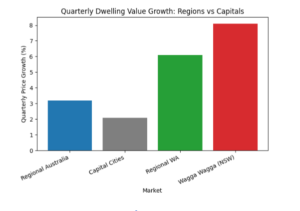
New data show that regional Australia’s housing market is booming compared to the capitals. In the three months to January, regional values rose 3.2% versus 2.1% in the combined capitals. This reflects ongoing affordability pressure and a wave of buyers moving to the regions. Driven by high city prices and tight supply, many households are escaping to country markets. For example, Western Australian regions saw 6.1% growth, and Wagga Wagga (NSW) jumped 8.1% over the quarter. 

Source 

We’re also seeing tight competition in the hottest markets. Homes in WA and Queensland now sell within ~20–24 days on market, and sellers are only dropping prices by about 3.3%. By contrast, a few slower regional towns (in NSW/VIC) have median time-on-market around 70 days, signalling looser demand. Rents are rising too: regional rents increased about 1.6% in the last quarter (versus 1.4% in the capitals) and have jumped ~42% over five years.

Key takeaways for buyers and investors

  • High demand for houses: Many buyers are fleeing city prices to find space and affordability. Demand is strongest for standalone homes on land, as families move out of the cities.
  • Tight stock, fast sales: Listings remain very low in top regional markets, so competition is fierce. In WA and QLD, homes now sell in a matter of weeks. Buyers should be prepared to act quickly with their best offer.
  • Rents and yields are rising: Regional rents have increased faster than wages (up ~42% in five years). That means rental yields are attractive in many areas, adding to capital growth for investors.
  • Beware slower pockets: Not all regions are booming. Some NSW/VIC markets have softened or even declined (e.g. Bowral–Mittagong, Batemans Bay). Thorough suburb-level research is essential to avoid over-priced or stagnant locations.
  • Pick the right state/region: Growth isn’t uniform. WA regions (+6.1%) and parts of QLD are outperforming, while many NSW/VIC areas lag. Target high-growth states and affordable regional hubs rather than chasing hype or overheated markets.

At Buyer Insight, we use insights like these to guide both first-home buyers and investors. We analyse local market trends, supply and demand, rental yields and growth prospects for each suburb. For every client, we focus on fundamentals like price, rental yield and growth potential – not hype. In fast markets, we move quickly; in slower ones, we dig deeper into research. If you’re thinking of buying, our team can help map out the best regional opportunities and avoid the pitfalls.

Ready to get started? Call us on 0468 444 478 or book a free 30-minute consultation. Follow us on Instagram and LinkedIn for the latest property insights and tips. Your property goals are our mission — let’s find the right home for you.

The Buyer Insight Difference | Data-Driven Buyers Agent Australia

The Buyer Insight Difference: Data-Driven Property Advice Built on Integrity and Transparency

The purchase of a house is among the most important financial choices of an individual. Nonetheless, a great number of buyers continue to base their market navigation aspects on assumptions, emotions, or partial information. It is at this point that Buyer Insight has its difference, in that it provides data-driven property advice based upon integrity, transparency, and real market intelligence, rather than sales pressure.

Buyer Insight will represent buyers as opposed to a conventional real estate agent in Australia. It is not about selling stock but securing the interest of the buyer through all phases of the property trip.

Why Data-Driven Property Advice Matters More Than Ever

This is a complex and dynamic property market in Australia. Buyer outcomes can be affected very easily by price changes, supply-demand imbalances, and policy shifts. As opinions or general advice are used, they may overpay or select the wrong asset.

A data driven buyers agent uses validated data, analytics, and research to make decisions. Buyer Insight analyses:

  • Trends and prices in the market.
  • Suburb performance and long-term growth indicators.
  • Comparable sales data
  • Capital growth and rental performance risk factors.

That is the way to have buyers make fully informed decisions that are not hype-based.

Read More: How Professionals Are Building Wealth Through Data-Led Investing

Buyer Insight The Spinal Cord of Integrity and Transparency

Conflicted advice is one of the greatest problems that buyers experience. Most consumers blindly rely on professionals who act as representatives of the seller.

Buyer insight works in a different manner.

Being a trusted property buyers agent Australia, Buyer Insight:

  • Does not take commissions with sellers and developers.
  • Gives straightforward advice. 
  • Reporting risks as well as opportunities.
  • Invests in the long run as opposed to short-term victories.

Such a transparent procedure instills confidence and makes sure that buyers are assured at all levels.

How Buyer Insight Supports Smarter Property Decisions 

Buyer insight is a combination of research, strategy and negotiation to provide an all-round advisory process. Regardless of the aim being home ownership or investment, all the recommendations are aimed at adhering to the financial goals of the buyer.

Key services include:

  • Rational choice of property.
  • Investment-grade asset evaluation.
  • Due diligence and risk assessment.
  • Type of negotiation support in order to prevent overpaying.

For buyers considering the services of the investment property buyers agent, this line system helps them eliminate the expensive errors and enhances the long-term results.

Buy Property with Confidence, Not Guesswork

Most customers believe that different agents offer the same advice. As a matter of fact, there is a difference in the recipient of the advice.

A buyers agent Australia is an agent of the buyer, not the seller. Buyer Insight’s role is to:

  • Get rid of emotional decision-making.
  • Determine poorly performing or overpriced assets.
  • Shield consumers against false market stories.

This is particularly crucial to the purchaser who needs to take into account complex options like purchasing property with SMSF whereby compliance, risk control, and quality of assets play an important role.

Frequently Asked Questions:

What is the difference between a buyers agent and a real estate agent?

Ans: A buyers agent acts in the interest of the buyer only, and a real estate agent is the agent of the seller. Buyer Insight gives independent advice that is centred on the objectives of the buyer only.

Is property advice based on data more credible?

Ans: Yes. The decisions supported by proven facts are less emotional and more effective with time to invest.

Does buyer insight assist in investment plans?

Ans: Absolutely. Buyer insight serves the needs of the buyer who wants long-term development, growth in yield and also property investment where the risk is controlled.

Does it ensure transparency during the process?

Ans: Yes. Buyer Insight is fully transparent as far as pricing, recommendations, and decision-making are concerned.

The reason behind Buyer Insight being a reliable brand in property advisory.

What truly differentiates Buyer insight is the combination of:

  • Research-backed insights
  • Buyer-only representation
  • Ethical advisory standards
  • Clear communication 

This makes Buyer Insight one of the best buyers agent Australia for buyers who would prefer transparent deals and long-term success rather than short-term deals.

Concluding remarks: 

Property success is not all about the time to get into the market but about making informed choices where one is well guided. Buyer Insight demonstrates that data-driven property advice, combined with integrity and openness, will produce greater buyer results.

In the event you are wanting a property buyers agent Australia who cares about you and minimises risk as well as provides clarity in a saturated market, Buyer Insight presents you with a smarter and more strategic solution.

In order to obtain personalised property advice, book a consultation with Buyer Insight.

Keep up with the specialists via Instagram and LinkedIn to receive expertise, market news, and customer-oriented information.

Using Equity to Buy Your Next Investment Property

For many Australian investors, owning one property is just the beginning. The real wealth-building starts when you learn how to use the equity in your existing property to fund your next investment. But for many, the idea of using equity to buy property feels complicated or risky. The truth is, when done strategically, equity can be one of the most powerful tools in growing a property portfolio.

At Buyer Insight, we help investors understand how to unlock equity safely, make informed decisions, and use it to purchase the right equity investment property that aligns with their long-term goals.

What is equity and why does it matters

Equity is the difference between what your property is worth and what you owe on your mortgage. For example, if your home is worth $800,000 and you owe $500,000, your equity is $300,000. That’s money you already own, and in the property world, it can be put to work to generate more wealth.

Equity isn’t cash sitting in a bank account, it’s the value tied up in your property. Using it to invest in another property allows you to grow your portfolio without having to save for a full deposit from scratch. This is one of the reasons Australians continue to use property as a long-term investment strategy.

How equity can be used to buy your next property

Equity can be used in a few different ways:

  1. Refinancing your existing loan: You can increase your mortgage slightly and use the extra funds as a deposit for your next property.
  2. Line of credit or redraw facility: Access available funds from your current mortgage when needed for an investment.
  3. Cash-out refinance: If your property has grown in value, you can release equity in cash to invest elsewhere.

The key is doing it in a way that doesn’t over-stretch your finances. Equity is a tool, not a free ride. The property you buy should be part of a strategy that balances growth, cash flow, and risk.

Why using equity can accelerate wealth

Using equity is like putting your property to work. Instead of leaving the value tied up in one place, it can help you buy another asset that earns rental income and appreciates over time. The equity in the first property continues to increase in value over time, so you compound that increase with equity that you have in another property. Therefore, the growth of two properties means an accumulated increase of wealth.

For investors in Australia, this strategy is particularly effective because property values generally rise over time, and the banking system allows borrowers to leverage their existing equity to fund further investments. When done correctly, it’s a way to grow a property portfolio faster than relying on savings alone.

Things to consider before using equity

Equity can be powerful, but it’s important to be strategic. Here are some key considerations:

  • Borrowing capacity: Using equity affects how much you can borrow. Make sure you understand serviceability and limits.
  • Cash flow impact: New mortgages mean new repayments. Ensure rental income and personal finances can comfortably cover them.
  • Property selection: Just because you can borrow more doesn’t mean you should buy any property. Look for equity investment property that fits your long-term strategy.
  • Market conditions: Interest rates, lending policies, and market trends all play a role. Timing matters.

At Buyer Insight, we work closely with clients to assess these factors. Our goal is to make sure equity works for you, not against you.

How to use equity strategically

A common mistake among many investors is viewing equity as a “bonus.” A far more intelligent way to utilise equity is to position your next property acquisition around the amount of equity available to you. You should have a clear understanding of the amount of equity that is available for your safe usage and align it with your overall portfolio objectives. 

For instance, should you be seeking long-term capital growth, you may wish to consider acquiring property in an emerging suburb with great potential as opposed to chasing higher rental yields. On the other hand, if cash flow is important to you, you may be better served by investing in areas with a demand for high rents/lots of rental return. 

Using equity as a strategic investment involves using all available equity to its fullest potential and getting you closer to your ultimate goals. 

Equity is a Tool for Your Property Investment in Australia 

In Australia, equity provides an incredible opportunity to maximise your investment portfolio and create long-term wealth through property. However, it should be viewed as a powerful tool, not as “free money”. To maximise the potential of equity for growing your property investment portfolio, investors must carefully consider how they will utilize the tool, develop a plan around their strategy, and make effective property selection choices. 

When used strategically, equity helps investors purchase additional properties, accelerate property value appreciation and create a portfolio that delivers cash flow (income) and capital appreciation (growth). If used incorrectly, equity can create financial hardship for an investor. 

At Buyer Insight, we focus on helping investors use equity wisely. Every property we recommend, every strategy we design, is aimed at building long-term outcomes rather than chasing quick wins. If you want to understand how to use your property equity effectively, start by creating a strategy that aligns with your goals. Also, don’t forget to book a free consultation and follow us on Instagram and LinkedIn.

Australia Housing Supply Crisis 2026: Buyer Impact

Why More Taxes Won’t Fix Australia’s Housing Crunch

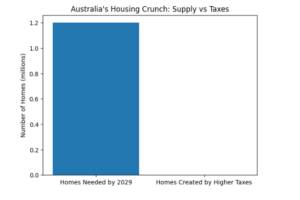
We often hear talk of more taxes or tighter rules to cool the housing market. But these miss the point. The real issue is supply – there just aren’t enough houses. Experts say Australia needs about 1.2 million new homes by 2029, but red tape and a shortage of tradies make that hard. Instead of more taxes, the government needs to back supply-side solutions to ease the crunch.

Source 

Housing is already one of the most heavily taxed sectors. Extra levies or fees would just raise the cost of buying without creating new homes, adding to inflation. Experts say the solution lies in building more houses and unlocking new land, rather than squeezing buyers.

Why supply is the real issue

Here’s what is driving the shortage and keeping prices up:

  • Chronic undersupply & high costs: Too few homes and rising taxes/fees mean prices stay firm.

  • Delayed estates: New land and greenfield projects stall without funding for roads and utilities, so fewer homes reach the market.

  • Construction bottlenecks: We’re short of builders and tradies, so projects take longer and each home costs more.

  • Tight lending rules: Banks now stress-test loans at higher rates. Many buyers can borrow less than they could a few years ago, making it harder to compete.

What it means for buyers

If you’re hunting for a standalone house, plan carefully and act quickly. These tips can help:

  • Know your budget: Get mortgage pre-approval and work with a broker so you know what you can borrow.

  • Prioritise location and needs: Consider suburbs with planned infrastructure and focus on what you really need in a home.

  • Be ready to act: Have your paperwork in order and be prepared to make a strong, quick offer in a competitive market.

  • Use expert help: A buyer’s agent and mortgage broker can spot opportunities, help with grants/schemes, and navigate tight lending rules.

Ultimately, supply constraints mean competition will stay tough. We focus on strategies to help you stand out – whether it’s maximising your finance, timing your purchase, or exploring less-crowded suburbs.

Ready to take the next step? At Buyer Insight, we guide both first-home buyers and investors through these market changes. We’ll calculate your borrowing power, compare loan options and help you prepare a strong offer. Call us on 61 468 444 478 or book a free 30-minute consultation. For daily tips and market updates, follow us on Instagram and Buyer Insight on Instagram, and connect on LinkedIn.

Off-Market Properties in Australia: What Serious Investors Look Beyond Online Listings

Most property buyers in Australia start their search by scrolling through online listings. They check realestate.com.au, domain.com.au, and wait for alerts about new properties. For people buying a home to live in, that’s often enough. But for serious investors, relying only on public listings can leave a lot of opportunities on the table.

At Buyer Insight, we work with investors every day who are surprised to learn how much of the property market never actually appears online. These are what we call off-market properties, and they’re a big reason why some investors get ahead while others struggle to find the right deal. In today’s competitive investment property Australia market, knowing where to look and who to work with can make all the difference.

What are off-market properties?

An off-market property is simply a home for sale that isn’t advertised publicly. There are no open homes, no listing on major portals, and often no price guide in the media. These properties are usually sold through networks of agents, private connections, or through a buyer’s agent representing an investor.

Off-market doesn’t mean secret. It just means the property isn’t being marketed widely. Sellers might want privacy, want to test interest before going public, or simply want a faster, cleaner sale without the hassle of weeks of inspections.

For investors, this is where the advantage lies. Less publicity usually means less competition, giving investors the chance to make smarter, more deliberate decisions. 

Why do Some Sellers Prefer Off-market

Understanding why a seller chooses off-market helps investors see why these properties exist. Some sellers want privacy and don’t want tenants, neighbours, or the wider market knowing they are selling. Others want to sell quickly and quietly, without weeks of waiting for offers or organising inspections. Some are testing the market before committing to a public campaign.

For investors, this creates opportunities that aren’t available to everyone. There’s often less competition, which can make negotiation easier. Sometimes the terms of sale are more flexible, settlement periods can be adjusted, and sellers may be more willing to consider offers that suit the buyer’s strategy.

Why Serious Investors Look Beyond Online Listings

Acquiring a property through a listing can often create a stressful experience. Some properties are so popular that they receive numerous offers from potential buyers. Typically, there will be large crowds at open homes, creating a highly charged emotional atmosphere for buyers. The pressure created by this competition often causes buyers to hurry their decisions, resulting in buyers overpaying for properties or attempting to acquire a property simply because it is popular with the general public.

Serious investors do not operate in this manner, focusing instead on developing a long-term investment strategy, utilising numbers to support their decisions, and analysing the future cash flows associated with their investments. This is why off-market properties are highly appealing to investors: the off-market nature of these properties allows investors time to research and make comparisons of properties while making their decisions free from the pressures created by being sold via a public campaign.

Additionally, having less competition and noise created by opening the properties for public viewing will allow investors the opportunity to adhere to their initial investment strategy. At Buyer Insight, we provide investors with access to off-market investment properties that are a good fit for them rather than just properties that will be listed on the market that given week. 

Off-market doesn’t Always Mean Cheaper

A common misconception is that off-market properties are always a bargain. That’s not true. Some are priced fairly; some even sell above market value. The real benefit isn’t always the price tag; it’s the control, the terms, and the access.

Being off-market can mean more flexible settlement terms, better clarity on the condition of the property, and fewer buyers trying to compete. For an investor, that peace of mind can be worth as much as a few thousand dollars off the purchase price. 

How buyer’s agents make off-market access possible

Off-market properties don’t just appear online. Access is built through relationships, trust, and knowledge. A selling agent is more likely to share a quiet opportunity with a professional they know and trust, rather than with every casual enquirer who might just be browsing.

This is where working with a buyer’s agent really pays off. At Buyer Insight, we maintain strong relationships with local agents, developers, and property professionals. That means our clients see opportunities before the wider market, and sometimes before the property even officially hits the market.

We also filter these opportunities carefully. Not every off-market property is worth pursuing. We make sure it fits the client’s strategy, budget, and long-term goals.

When Off-market Works Best

Off-market properties are particularly useful in competitive areas, tightly held suburbs, or when investors have very specific requirements. They’re also ideal for investors who care more about long-term fundamentals than short-term hype.

When a property isn’t publicly listed, decisions are made based on strategy and numbers — not urgency, emotion, or fear of missing out. For an experienced investor, that kind of environment is far more comfortable and productive.

Off-market is About Strategy, not Shortcuts

It’s important to understand that off-market properties aren’t magic. They’re not a shortcut to building wealth. A poorly chosen off-market property is still a poor investment. The advantage comes from using off-market access strategically, as a way to find properties that truly align with your long-term goals.

At Buyer Insight, we make sure every opportunity, on-market or off-market, is carefully assessed. Access alone doesn’t guarantee success. It’s what you do with it that counts.

Look beyond What Everyone Else Sees

Most buyers see only what’s advertised. Serious investors know that some of the best opportunities aren’t public at all. Off-market properties give you access, time, and flexibility, all of which make better investment decisions possible.

In a competitive investment property Australia, looking beyond online listings isn’t just smart. It’s essential. And when you pair access with strategy, you can consistently find opportunities others miss.

Stay connected with Buyer Insight

For property insights, investment education, and access to off-market opportunities, follow Buyer Insight on. You can book a free consultation and follow us on Instagram and LinkedIn.


$10bn Housing Future Fund in 2026: When New Supply Reaches Buyers

Australia’s $10bn Housing Future Fund: What Buyers Need to Know

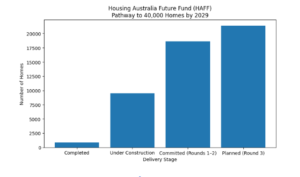
The Albanese government’s new Housing Australia Future Fund (HAFF) is a $10 billion program to build 20,000 social and 20,000 affordable homes over five years. So far, the first two funding rounds have locked in 18,650 homes (279 projects) for people in need – about 889 completed and 9,501 under construction. Round 3 of the fund opened on 30 January 2026 and will provide the remaining 21,350 homes needed to hit the 40,000 target by 2029. In practical terms, this means more housing supply is on the way, but slowly. All these new homes are scheduled to be built from 2027 onwards, so any market impact will be years in the making.

Source 

Round 3 Key Details

Round 3 aims to accelerate delivery through partnerships and focused streams. Key points:

  • 21,350 homes to go: This round will fund the remaining homes needed to reach the 40,000‑home goal.
  • Jan 30, 2026 launch: The funding call opened on 30 January 2026, in an open, non‑competitive process (applicants can submit proposals at any time until funds are used).
  • 1,200+ per state: It guarantees at least 1,200 homes in each state/territory, ensuring a nationwide distribution of projects.
  • First Nations focus: $600 million is set aside for First Nations housing organisations, and at least 10% of all new social homes must be for First Nations households (helping meet Closing the Gap goals).
  • Timeline – keys from 2027: The fund specifically targets “keys in doors” as soon as possible. Rolling completions start in 2027, with all dwellings due by mid‑2029. Projects are chosen for their value-for-money and long-term community benefit.

What This Means for Buyers

From a buyer/agent perspective, it’s great to see new homes coming, but remember: supply relief is gradual, not immediate. The HAFF homes (mostly new social or affordable units) won’t hit the market for a few years. In fact, fewer than 900 homes are complete so far, and the rest are in planning or building. So in the near term, the property market will remain tight. Demand still outpaces supply in most areas, keeping prices high – especially since these new units are earmarked for lower-income renters rather than the broader market.

Buyers should take a local view, not national headlines. Impacts will be location‑specific: if a Round 3 project is in your suburb, you might see some relief down the track; otherwise, your market probably won’t change much. As a buyer’s agent, we advise watching micro-markets: check local vacancy rates, housing stock, and upcoming developments. Some easing of pressure is likely at the cheaper end of rentals (more social housing means slightly more low-cost rooms for rent), but don’t expect house prices in hot markets to suddenly fall.

  • Supply boost is slow: Deliveries only ramp up from 2027, so expect tight conditions for a few years yet.
  • Tight market persists: Nationally, experts still see a housing shortage. Median prices keep rising while new stock trails population growth. Don’t assume prices will crash anytime soon.
  • Local factors rule: Benefits vary by suburb. A coastal city or commuter town with new projects might feel pressure ease more than a built‑up inner suburb. Always check local data.
  • Focus on fundamentals: For buyers and investors, the best strategy is picking the right suburb and property type for you – not betting on big policy shifts. Use a buyer’s agent to find good value in micro-markets, and keep an eye on local supply trends.

Next Steps

Ready to get started? At Buyer Insight, we help first-home buyers and investors navigate these market changes. Call us on 61 468 444 478 or book a free 30-minute consultation to take the next step. For ongoing tips and updates, follow Buyer Insight on Instagram and LinkedIn.
Is It Better to Buy a Home to Live In or an Investment Property First?

For many Australians, the first big property decision isn’t about location or budget. It’s a much bigger question: Should I buy a home to live in first, or should I start with an investment property?

At Buyer Insight, we speak to buyers every week who feel stuck between these two options. Both choices have strong benefits, and both come with long-term implications. When deciding what kind of property to purchase, it is essential to consider what fits best with your lifestyle, personal finances, and future hopes and dreams, rather than just buying the property that seems like the best deal at the time.

In this blog, we are going to discuss how to buy while maintaining success based on your goals as they relate to homeownership vs rental properties.

Buying a Home to Live In: What It Means

When you buy your own home (also called an “owner-occupier property”), you are purchasing a place for your family, comfort, stability, and lifestyle.

Advantages of buying a home first

  1. Stability and control
    You don’t need to deal with landlords, rent increases, or moving often. You can renovate, repaint, personalise, it’s your home.
  2. No capital gains tax
    If you purchase a primary residence today and sell at a later date due to appreciation in value, you typically will not be required to pay capital gains tax on the profit from the sale, which is an advantage of buying a home now.

Ultimately, both paths can result in long-term financial success for you. 

  1. Emotional satisfaction
    Owning your first home is a major achievement. Many buyers prefer this path simply because they want security and a space that feels like theirs.

The downsides

  • Your borrowing power may be lower compared to buying an investment. 
  • Your home generally costs you money each month because it doesn’t generate rental income. 
  • You may buy in a more expensive area where growth might be slower.

So buying a home is great for lifestyle but not always the strongest financial strategy.

Buying an Investment Property First: What It Means

Buying an investment means purchasing a property that you do not live in. Instead, you rent it out to tenants, and the rent helps cover the mortgage.

Advantages of buying an investment first

  1. Someone else helps pay your loan
    Your tenants’ rent reduces your out-of-pocket costs and helps you build equity over time.
  2. Tax benefits
    You can claim expenses, depreciation, interest and other deductions which may help your overall cash flow.
  3. Start building wealth earlier
    If you choose a strong-growth area, you can build equity faster and use it later to buy your dream home.

The downsides

  • You don’t get the emotional satisfaction of owning your own home yet. 
  • Investment properties require maintenance, management, and financial discipline. 
  • Vacancy periods or unexpected costs can affect your cash flow.

If you are looking to accumulate wealth earlier or will enter the real estate market sooner, investing can be a very powerful way to start; however, it does take careful consideration and planning. 

So Which One Is Better? Home or Investment?

There is no universal answer. It depends entirely on your situation.Here’s how we help clients at Buyer Insight think about the decision:

1. What is your main priority right now?

  • Lifestyle and stability? → Home may suit you better. 
  • Building wealth and entering the market earlier? → Investment may be smarter.

2. Where do you want to live vs. where you can afford to buy?

Many Australians cannot afford their preferred suburb, but they can afford to invest somewhere with strong growth.
This strategy is often called rentvesting and is very common in Sydney and Melbourne.

3. How long do you plan to hold the property?

If you plan to move often or only stay for 2–3 years, an investment may be better.
If you want to settle long-term, buying a home may make more sense.

4. Your financial structure

Your borrowing power, income, savings, dependants and job stability all matter.
A buyer’s agent can help you assess which option strengthens your financial position.

5. Your personality

Are you comfortable with tenants, numbers and investing?
Or do you value certainty and having your own space?

Knowing your comfort level is just as important as knowing your budget.

Why Buyer Insight Recommends a Strategy, Not a Side

At Buyer Insight, we never push buyers towards “home first” or “investment first.”
We guide you towards the strategy that makes the most sense for where you stand today and where you want to be in 5–10 years.

We look at:

  • Your long-term goals
  • Your borrowing strength
  • Your preferred suburbs
  • How soon do you want to upgrade
  • Your lifestyle needs
  • Your appetite for investment

Once we understand your situation, we map out the path that gets you closer to your ideal home and a stronger financial position without unnecessary stress or guesswork.

There is no one-size-fits-all answer. We welcome the opportunity to assist you in evaluating your options for your financial future. Buyers’ Insight can assist you in determining a path towards homeownership or investing in rental property with respect to your financial situation and your long-term goals. 

If you’re unsure whether to buy your own home first or start with an investment, Buyer Insight can help you work out the right path based on your goals. You can easily schedule a free chat through our booking link here. If you want to talk about how we can help you with your purchase decisions, please feel free to reach out to us for a free consultation.

For more updates and property insights, feel free to follow us on Instagram and connect on LinkedIn.

Australia’s Capital Cities See Another Year of Price Growth

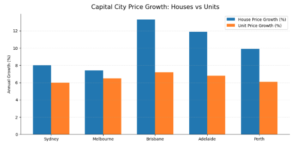
Australia’s capital cities saw record price growth in 2025. Domain reports combined capitals rose about 9.6% (median) for the year, the 12th straight quarterly rise. In fact, six of our eight capitals now have median house prices over $1 million. Perth just joined the “million-dollar club” after a 9.9% jump in late 2025. Melbourne is back in growth (about +7.4% for the year), and Brisbane and Adelaide saw double-digit gains (Brisbane ~+13.3%, Adelaide ~+11.9%). Unit markets are rising too (up ~6.8% nationally). In short, prices are climbing broadly, driven by low supply and strong demand.

Source 

Key Market Trends You Need to Keep in Mind 

  • Record highs across the board. Combined city house prices surged 9.6% in 2025, with all capitals (except Canberra) at all-time highs.
  • Million-dollar capitals. Six capitals now have median houses above $1 million (Perth just crossed $1.0M after its 9.9% spike).
  • Widespread growth. Melbourne’s market rebounded strongly (+7.4% in 2025), and smaller capitals (Brisbane, Adelaide, Perth, Darwin) led the surge.
  • Tight supply. Analysts note persistent low inventory – this sellers’ market is fuelled by high clearance rates and stiff competition.
  • Houses vs units. Even with rising prices, most buyers still prefer standalone houses. Land, space and future growth continue to outweigh the short-term savings that units may offer. 

What it means for buyers

As a buyer’s agent, these trends are making the market tougher for home-hunters. More buyers chasing fewer homes means you must be prepared. Tight supply and rising prices mean competition is heating up – expect bidding wars at auctions and fast-moving offers. “Affordable” markets are shrinking fast: even Perth (once cheap) now has $1M+ houses. First-home buyers and investors must adjust budgets accordingly.

The house-versus-unit gap is widening. The price gap between houses and units is becoming more noticeable in many cities. In markets like Sydney, a detached house can cost significantly more than an apartment, which is why some buyers are widening their search to include units. At the same time, well-located apartments—especially in inner-city areas—are attracting strong interest, so competition isn’t limited to houses alone. The right choice really comes down to your budget, lifestyle and long-term plans. For some buyers, a house still makes sense for space and future flexibility; for others, a unit can be a practical entry point. Either way, understanding where demand is building helps buyers make informed, confident decisions. If you’re budget-conscious, consider higher-density living, but be ready to act, as investors and first-timers are chasing them too.

Don’t wait too long. With prices rising ~9–13% per year in many markets, each month you delay can add tens of thousands to your budget. If you wait a year, a home that was $800K might cost $880K. In this environment, a clear strategy beats rushing. Instead of scrambling, work out your price range (get finance pre-approval), shortlist target areas, and be ready to move when a suitable property appears. A buyer’s agent’s job is to help you do exactly that – crunch the numbers, research local trends, and execute the plan smoothly.

Next Steps to Take for a Better Future

Ready to navigate this changing market? At Buyer Insight, we guide both first-home buyers and investors through these shifts. We’ll assess your borrowing power, help pinpoint suburbs that match your budget and risk profile, and negotiate on your behalf. Speak with our team today: call +61 468 444 478 or book a free 30-minute consultation. For more tips and updates, follow Buyer Insight on Instagram and connect on LinkedIn.

SMSF Property Investment Strategy: A Data-Driven Formula to Build Property Wealth.

Data, SMSFs, and Strategy: The Proven Formula for Building Wealth Through Property


The development of long-term wealth on the basis of property is hardly a matter of luck or of time. In the modern market environment, which is highly complex, the ability to become a successful investor depends on a proven formula that involves the use of data-supported choices, intelligent structuring, and a well-thought-out long-term strategy. This is precisely why most Australians are now resorting to a buyers agent Australia in making important decisions that have huge capital investment as well as long-term implications.

The key element in this strategy is the use of data to drive investment in property, and this trend has been aided by the increased interest in purchasing property through SMSF-based structures to enable investors to have control, transparency and long-term planning.

The reason is data at the beginning, not emotion.

A majority of all property errors occur when making decisions based on an urgent or hyped or envious basis. Data changes that.

Instead of responding to the headlines, sophisticated investors (more often with an investment property buyers agent behind them) engage in evidence-based thinking like:

  • Observing long-term trends in capital growth is crucial.
  • Sophisticated investors understand the fundamentals of supply and demand.
  • The changes in demographics and the pipeline infrastructure are also important factors to consider.
  • Rentals and holding costs are significant considerations in cyclical markets.

This approach helps buyers avoid the pitfalls associated with other purchases, particularly by targeting off-market properties that are selected based on their performance rather than their appearance.

SMSF Property Investment: Speed is more of the essence than structure.

Buying property with SMSF has become a strategic method of accruing wealth in the form of superannuation for many Australians. However, in this case, success relies more on form than time. 

When investing in property through an SMSF, one must carefully consider the following factors:

  • The sustainability of cash flow within the super is crucial.
  • SMSF lending regulations.
  • Exposure to risk in the long run.
  • The long-term alignment of exit and retirement strategies is crucial.

Unless guided accordingly, the SMSF buyers would find themselves trapped in assets that restrict flexibility. This is the place where strategic support, rather than making fast decisions, will be of paramount importance.

The most important strategy layer is often misunderstood by investors.

Data identifies what to buy. The structuring of your investments and the SMSF (Self-Managed Super Fund) determine how you should purchase properties.

Strategy has to do with why a certain property fits in with your overall picture financially.

A clear strategy examines:

  • A clear strategy scrutinises the type of asset, be it growth or income.
  • The impact of this purchase on future borrowing capacity is also taken into consideration.
  • The contribution limits and the role of equity may change over time.
  • There are options for exiting the purchase under different market conditions.

It is this reasoning that triggers the distinction between the purchase made by oneself and the building of wealth that can be scaled up – and why most investors are looking to engage the best buyers agent Australia to assist in securing long-term results.

What is proven in this formula— not only advice?

Repeatability is the distinction between advice and a proven formula.

The reason behind the effectiveness of this framework is that it can always be applied:

  • Data to remove emotion
  • The SMSF structure serves to manage risk effectively.
  • Planning to secure future decisions.

Buyers stick to a set of rules that will continue to work even when lending laws are tightened or the mood changes.

The Reason Why Buyer-Led Strategy Has a Difference.

Conventional methods of transacting property tend to give more emphasis to what is present. A buyer-led strategy is more interested in what fits.

The use of a buyer’s agent in Australia is guaranteed to:

  • The inspections commence with the filtering of properties.
  • The negotiations are based on facts and not coercion.
  • In hot markets, buyers do not pay too much.

This is particularly necessary in SMSF purchases and long-term investments, which are expensive and hard to undo.

Real-World Application: Growth Does Not Come Through Pressure but Planning.

Market cycles cannot be avoided. Investors who think beyond the present stage are designed to build strong portfolios.

Individuals who merge data, structure and strategy usually:

  • Hold assets longer
  • Reduced forced sales.
  • Keep self-confidence when changing the rates or policies.

They do not follow momentum, but they depend on preparation.

Final Thoughts

At Buyer Insight, property decisions are made with the help of data, structure, and long-term thinking, and not pressure and assumptions. The proper process is the difference between you enquiring about SMSF property investment and making your next strategic purchase.

To learn more about buyer-led strategy, market intelligence, and smarter property decisions, you can subscribe to Buyer Insight on LinkedIn and Instagram, where you will find practical advice and commentary on the market regularly.

As much as you are prepared to know how data, SMSF structuring and strategy can help you in a personal situation, then a confidential buyer consultation may help you to know the next step, not to be influenced by emotion or timing to make the decision.

Australia’s Housing Wealth Gap and What Buyers Face

Recent data shows a widening generational gap in housing wealth. In fact, Gen X (born 1965–80) now holds the most property wealth, about A$1.445 million on average, exceeding Baby Boomers’ $1.360M. Boomers remain the richest overall (avg $2.375M net worth) but are shifting cash into safer assets (superannuation and term deposits) as they retire. Millennials (born 1981–96) lag far behind with roughly $905K net worth and carry the highest debt burdens.


Keys Details You Cannot Ignore 

  • Gen X leads in home equity ($1.445M on avg).
  • Boomers: highest liquid wealth (>$220K cash/deposits) and largest super balances.
  • Millennials: lowest property wealth (~$890K) and avg loans ~$460K, making their homes largely a net liability.
  • Wealth transfer: Analysts note a “great wealth transfer” underway as Boomers downsize and hand over assets.
  • Timing bonus: Those who bought in the 2020–21 low-rate boom have seen ~63% wealth gains, but with rates up, “that home ownership window is now firmly closed”.

These trends matter a lot for today’s buyers. First-timers and investors now often compete against equity-rich households. Retirees can tap big deposits or offset accounts to outbid buyers at auctions, while younger buyers face wider deposit and borrowing gaps. With Boomers “beefing up their super and cash accounts”, borrowers with limited savings may struggle to match quick, high offers.

Timing is critical. Buyers who entered the market on ultra-low rates (2020–21) are seeing strong gains. New buyers without that benefit must be extra strategic: choosing the right suburb, targeting homes with upside, and being patient. Location and asset choice are key – well-timed purchases in growth corridors can pay off long-term, whereas jumping into overpriced markets may saddle you with debt. At the same time, negotiations are tougher when facing cash buyers. Often, the first bidder with a larger deposit wins.

As a buyer’s agent, our advice is to buy smart, not just fast. Plan for the long term: lock in finance early, consider inspections and off-market deals, and don’t overextend. Even small suburbs or emerging markets can deliver growth while reducing competition. Remember, property is still the cornerstone of wealth in Australia – but how and when you enter the market can make all the difference.

Next Steps: Buyer Insight can help both first-home buyers and investors tackle these challenges. We’ll assess your borrowing power, refine your search (and even tap off-market listings), and negotiate strongly on your behalf. Connect with us for a personalised strategy.

Call at 61 468 444 478 or book a free 30-minute consultation. Follow us on Instagram and LinkedIn for more property insights.