
All posts by admin

National House Price Growth Slows: What Buyers Need to Know Now

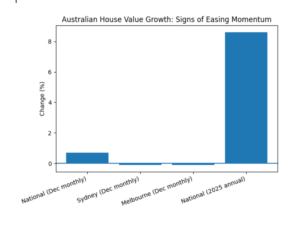
National house values are still rising, but the pace is easing. December’s national growth was just 0.7%, the smallest monthly increase in five months. Overall, 2025 saw a strong 8.6% gain, but even those lofty annual figures hide plateaus in priciest markets. Sydney and Melbourne, for example, each slipped about 0.1% in December. This isn’t a sign that values will collapse, after all, prices have come a long way, but it does show that steeply-priced cities can’t ignore affordability constraints. For buyers, that means being realistic about entry prices and not assuming every slowdown brings a bargain.
Source


Mixed market signals

Across Australia the picture is mixed. Perth and Adelaide posted the strongest gains in December (+1.9% each), while Darwin and Brisbane rose 1.6%. Demand is concentrated in more affordable pockets. Economist Nerida Conisbee notes the expanded 5% deposit scheme is “really accelerating growth” at that price point. In October 2025 the government broadened the Home Guarantee scheme so first-home buyers (and eligible single parents) can purchase with just a 5% deposit. In practice, that means intense competition for sub-$1 million homes in Brisbane, Adelaide and other cheaper markets even as the top-end cities cool.

Borrowing power matters

Even in slowing markets, entry-price discipline is vital. Sydney’s median house price is around $1.5 million, far above the $991,331 median of all capitals and $901,257 nationally. At those levels, many buyers simply can’t qualify without large deposits. New APRA rules now cap high-debt loans: only 20% of new mortgages can exceed six times the borrower’s income. In short, borrowing limits, not just headline prices, will determine what you can afford. If you don’t meet those limits, it’s often wiser to focus on more affordable areas where your budget can secure a home.

Focus on fundamentals

The cooling in some metros highlights that selection matters more than timing. Look for markets with tight supply and steady demand. Conisbee points out “pockets of relatively affordable housing”, Perth, parts of Queensland, Adelaide and even Melbourne apartments, that remain resilient. A buyer’s agent filters hype and prioritises these fundamentals: we match your borrowing power and goals to suburbs where prices fit, rather than chasing headlines. In a subdued market, picking the right property and place will always matter most.

Ready to get started? Buyer Insight provides support to first-time homebuyers and investors during this time of uncertainty. The new lending criteria require you to calculate your real lending capability; however, we help you to compare loan products so you know exactly how to take advantage of the new Home Guarantee Scheme, which allows for a 5% deposit. Contact one of our staff members today at 0468 444 478 or schedule a free 30-minute consultation to discuss your objectives. Follow us on Instagram and LinkedIn for additional information regarding purchasing a home.

Housing Affordability Reaches 15-Year High Pressure Point

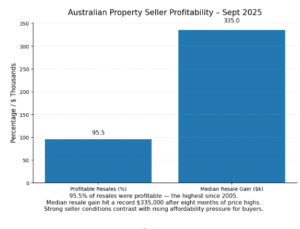
Australian residential property sellers are experiencing their most profitable conditions in more than 20 years. In the September 2025 quarter, 95.5% of homes resold across Australia achieved a nominal profit, the strongest result since 2005. This surge was driven by a revitalised housing market, with national home values setting record highs for eight consecutive months and the median resale gain rising to a new peak of $335,000. While these figures highlight the strength of recent price growth, they also set the backdrop for growing affordability pressures and higher borrowing costs confronting today’s buyers.

Source 

Families moving for affordability

Many buyers are relocating for cheaper living costs, often trading capital city prices for a rural lifestyle. One recent example: a Brisbane family moved from Toowoomba to Blackwater in central Queensland. By doing so, they slashed their mortgage from about $740 to $330 per week. They also benefited from higher incomes (the husband landed a new mining job), so their overall budget improved. However, these moves come with trade-offs. Smaller towns have fewer homes for sale, so you often face tight competition. In the Ballini family’s case, “every time we found one [five-bedroom home], it was already under offer. In short, regional markets are smaller and demand can flood in quickly, driving prices up. PropTrack’s Angus Moore warns that as more people move out, those “more affordable” areas see even faster price growth, and he doesn’t expect prices to ease any time soon.

What buyers should watch

As buyer’s agents, we coach our clients to balance location risk with affordability. Here are key focus points:

  • Location vs Affordability: Regions outside the capitals can offer lower entry prices, but they carry higher volatility and fewer buyers. Check job growth and local infrastructure before committing.

  • Regional Market Strength: Many regional QLD towns have outpaced city growth. For instance, Blackwater’s 15% home-price rise was well above Sydney’s 6.5% and Melbourne’s 4% gains. Strong growth can signal opportunity, but also foreshadow peaking demand.

  • Stock Scarcity: Supply is a big factor. In tight markets, listings disappear fast. As Moore notes, even a small influx of buyers can make it “challenging to find homes” in a town with few listings. Be prepared to act quickly and bid confidently.

  • Lifestyle vs Investment: Some buyers move for lifestyle (lower living costs, more space). That makes sense — the Ballini parents now enjoy a friendlier community and lower bills. Just remember that remote areas may take longer to sell or change value if major industries shift.

  • Market Outlook: PropTrack’s latest report emphasises that prices aren’t expected to fall soon. This underlines the need for long-term planning. Don’t assume relief; instead, build a strategy that covers high mortgage costs and focuses on sustainable suburbs.

In short, today’s market rewards buyers who take a careful, well-researched approach. That’s where we come in. We are buyer agents who assist clients in understanding all the relevant financial details related to purchasing a home, including the amount they can borrow, financial product alternatives, and which suburb(s) they should focus on based on their long-term residential goals. We take all of the market data available that can be overwhelming and turn it into easy-to-understand, sound, actionable recommendations so that clients can continue to move toward their home ownership dreams with confidence. 

Need expert guidance?

Looking for some guidance? Buyer Insight works with both first-home buyers and investors to help them navigate the market with clarity. We’ll walk you through your budget at today’s interest rates, compare suitable loan options, and identify areas that balance affordability with long-term growth.

You can also call us on 61 468 444 478 or book a free 30-minute consultation. Follow us on Instagram and LinkedIn for more property market tips and updates.

High-Income Professionals & Financial Freedom: Why Most Still Feel Financially Stuck

Earning a high income should make life easier. It should give you more freedom, less stress, and the confidence to plan your future without worry. But for many high-income professionals, doctors, engineers, IT specialists, executives, and consultants. However, the reality is very different.

They earn well.
They save well.
But they still feel financially stuck.

At Buyer Insight, we speak with many professionals who earn well above the national average, yet feel they are not moving closer to financial freedom. The reason isn’t a lack of income. The real issue is a lack of a wealth strategy, specifically one built around smart, consistent, property investing.

This blog breaks down why high-income earners stay stuck, and how a strategic, data-led property plan can help them finally create the financial freedom they work so hard for.

The Financial Freedom Problem No One Talks About

Many high-income professionals follow the same pattern:

  • Work long hours

  • Pay high tax

  • Save what’s left over

  • Spend on lifestyle

  • Repeat

This cycle feels comfortable, but it does not build wealth.
The truth is, income alone doesn’t make you financially free and assets do.

Financial freedom comes from:

  • Owning appreciating assets

  • Having passive income

  • Building equity

  • Creating options for the future

That is why so many high-income earners feel stuck: they rely on income, not assets.

Why High-Income Earners Often Fall Behind in Wealth Creation

1. High Tax Brackets Eat Away at Earnings

The more you earn from your job, the more tax you pay.
But when you invest in property, you redirect money into an asset that grows and can also provide tax benefits.

Professionals who don’t invest end up working harder without getting ahead.

2. Lifestyle Inflation Takes Over

As income grows, lifestyle grows too:

  • Bigger car

  • Better holidays

  • More expenses

  • Higher rent or home upgrades

These things bring comfort, but they don’t bring financial freedom.
Lifestyle spending feels rewarding today but creates pressure tomorrow.

3. Lack of Time to Study the Market

Many high-income earners are experts in their field, not in property.

They simply don’t have the time to:

  • Analyse suburbs

  • Study data

  • Track supply and demand

  • Review infrastructure growth

  • Negotiate deals

  • Compare markets across states

This lack of time leads to delayed decisions or costly emotional purchases.

4. Fear of Making the Wrong Investment

Because professionals are used to being right in their careers, they fear making a mistake with property.

So they:

  • Overthink

  • Stay in research mode for years

  • Keep waiting for the “perfect time”

  • Miss out on market cycles

Meanwhile, those who buy strategically build wealth quietly in the background.

5. They Don’t Follow a Data-Led Strategy

High-income earners often rely on:

  • Friendly advice

  • News headlines

  • Social media opinions

  • Emotional choices

But true wealth is built using data, not opinions.

A strategic, data-led approach shows:

  • Growth suburbs

  • Market timing

  • Property performance

  • Rental strength

  • Future infrastructure zones

This is how top investors get ahead by following evidence, not emotion.

Property: The Most Reliable Path to Financial Freedom for High-Income Earners

Professionals who achieve financial freedom don’t rely on savings alone.
They build long-term, stable, compounding wealth through property.

Here’s why property works so well for high-income professionals:

1. Property Leverages Your Income

Your strong income gives you borrowing power.
Your borrowing power gives you access to quality assets.

When used wisely, this helps you build wealth much faster than savings.

2. Property Grows Even While You Work

Capital growth and rental income continue even when you’re:

  • At work

  • On holiday

  • Asleep

  • Spending time with family

This is how you move from working for money…
to having money working for you.

3. It Is a Proven Long-Term Wealth Builder

Generations of Australians have created wealth through:

  • Compounding growth

  • Rising demand

  • Limited supply

  • Strong rental markets

For high-income earners, the combination of strong earnings + good assets becomes extremely powerful.

4. It Creates Options for The Future

A strategic property portfolio can give you:

  • Early retirement

  • Higher passive income

  • More family time

  • The option to reduce work hours

  • Greater lifestyle choices

These benefits are what “financial freedom” truly means.

Why Many High-Income Earners Now Work With Buyer Insight

Today’s professionals know that buying the right property requires:

  • Deep market research

  • Data analysis

  • Understanding long-term performance

  • Skilled negotiation

  • Access to off-market opportunities

At Buyer Insight, we help high-income earners make smarter, faster, and more confident decisions by:

✔ Using a data-led approach
✔ Identifying high-growth suburbs
✔ Evaluating property types proven to perform
✔ Avoiding risky markets
✔ Negotiating the best possible price
✔ Ensuring each purchase supports long-term financial freedom

Our goal is simple:
Turn your strong income into strong assets.

You Don’t Need More Income: You Need a Better Strategy

If you are a high-income professional who still feels financially stuck, the problem isn’t your earnings.
It’s that your money isn’t being directed into the right places.

A well-selected property can outperform years of savings and help you finally move towards the financial freedom you’ve been working hard for. You also need to understand that it is important to buy strategically, not emotionally. 

Yes, if you also want to build financial freedom and smartly invest in properties, join us at Buyer Insight now. We can help you with a clear and clever plan to learn about the journey towards wealth. So, book a free consultation with us and follow us on LinkedIn and Instagram.

How Professionals Are Building Wealth Through Data-Led Investing

When you look at today’s property market, one thing is very clear: the most successful investors and upgraders are no longer relying on guesswork. They are building real, long-term wealth by using data-led investing. This is a smarter, calmer, and far more strategic way to buy property.

At Buyer Insight, we see this shift every day. Professionals who once depended on “gut feeling” are now using clear data, evidence and market trends to make confident property decisions. And the results speak for themselves.

Whether you are planning to invest, upgrade your family home, or build a stronger financial future, understanding how data-led investing works can completely change your journey.

Why Data-Led Investing Matters Today

The Australian property market has always moved in cycles. But in the past few years, buyer behaviour has changed quickly. Rising interest rates, low supply, strong migration, and shifting lifestyle needs have created a more competitive environment.

In this type of market, data becomes your strongest advantage.

Data gives you:

  • Confidence instead of uncertainty

  • Clarity instead of confusion

  • A plan instead of pressure

  • An edge over emotional buyers

Professionals are no longer buying because a suburb “feels nice.” They are buying because the numbers show long-term growth, rental demand, strong infrastructure, and future upside.

What Data-Led Investors Look For

At Buyer Insight, our approach to analysing data depth in an area includes several data analysis levels to be able to provide a recommendation for your suburbs and properties. For professionals today, the focus is on:

1. Suburb Growth Trends

All suburbs are not created equal, and therefore, when looking for an investment opportunity it is Important to have a clear understanding of what the suburb is doing in regard to the 5-10 Year Growth, the change in median property Value, total number of property sales hyper local to the suburb as well as any current gentrification pattern and the indication of gentrifying suburbs, so you know we’ve selected the right suburbs for you.

2. Rental Demand & Vacancy Rates

Investors especially focus on rental strength.
High demand and low vacancy rates usually mean:

  • Strong rental returns

  • Stable tenancy

  • Lower risk during market dips

With Australia facing a rental shortage in many pockets, this data has become more important than ever.

3. Infrastructure & Employment Growth

Professionals want to buy where future demand will naturally increase.
So they follow:

  • New transport links

  • School catchments

  • Hospital expansions

  • Commercial zones

  • Employment hubs

These are areas where people want to live, which pushes prices upward over time.

4. Property Type Performance

Data clearly shows which property types outperform in a given suburb, whether it’s townhouses, houses on larger blocks, boutique apartments, or something else.

This avoids costly mistakes like buying a property type that underperforms or has weak resale value.

5. Demographic Shifts

Younger families, downsizers, migrants, and remote workers all influence demand.
Professionals study how demographics are moving and which areas are benefiting.

Why Buyer Insight Clients Prefer a Data-First Approach

Buying property in Australia is not just about finding something “nice.”
It’s about understanding:

  • Where the market is heading

  • How the numbers support the decision

  • Whether the property will outperform others

  • Whether this move strengthens long-term wealth

At Buyer Insight, we help everyday Australians buy the right property using:

✔ Detailed market research
✔ On-the-ground local experience
✔ Suburb comparison models
✔ Data tools and property reports
✔ Access to off-market opportunities
✔ Negotiation experience that saves money

This combination reduces risk and increases the chance of long-term capital growth.

How Professionals Are Using Data to Build Wealth

Modern property investors follow a simple but powerful method:

Step 1: Identify high-performing pockets using data

They do not chase the “hot suburbs” everyone is talking about.
Instead, they find rising areas before they boom.

Step 2: Buy the right property type, not just the right suburb

A good suburb with a poor-performing property still becomes a bad investment.
Data helps them pick the best-performing dwelling within that area.

Step 3: Focus on long-term capital growth

Professionals understand that wealth isn’t built by timing the market perfectly but by buying a strong asset and letting the data-backed growth play out over years.

Step 4: Remove emotions from the decision

A data-led plan keeps buyers calm, patient, and strategic, especially during bidding and negotiations.

Step 5: Work with experts who analyse the numbers daily

This is where a buyer’s agent becomes a major advantage.

The Role of a Buyer’s Agent in Data-Led Property Investing

As buyer’s agents, we live and breathe the numbers every single day.
At Buyer Insight, our role is to:

  • Reduce your research time

  • Analyse suburbs on your behalf

  • Shortlist the strongest investment options

  • Access properties not available to the general public

  • Negotiate the lowest possible price

  • Help you buy an asset that performs for years

The goal is simple:
Buy better. Build wealth faster. Reduce mistakes.

Professionals don’t buy alone, because they know the cost of buying wrong is far bigger than the cost of expert help.

Why This Matters for Investors & Upgraders Right Now

If you are planning to:

  • invest in your first property,

  • upgrade to a bigger home, or

  • expand your portfolio…

…then this is the time to be strategic, not reactive.

The people building wealth today are the ones using:

  • better data

  • better planning

  • better guidance

  • better negotiation power

The market will always move, but data helps you move with confidence.

Ready to Build Wealth With a Data-Led Property Strategy?

If you want expert support, a clear plan, and the confidence of data-driven decisions, we at Buyer Insight are here to help. Not only this, but Buyer Insight can help you achieve your goals. For more information on Data-driven investing, schedule your FREE consultation today. Also, don’t forget to follow us on LinkedIn and Instagram to stay updated with the latest market trends.

House Prices Are Rising: What Buyers Need to Know for 2025–2027

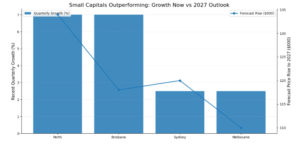
Westpac’s latest forecast shows strong price growth to 2027. In Perth, for example, median house prices could rise by about $134,000 in that time. Sydney’s median is tipped at around $1.7 million, and Canstar finds five of six capitals may exceed $1 million medians by 2027. In short, waiting to buy often means paying significantly more later.

Small capitals are outperforming the big two. As Westpac notes, As Westpac notes, Perth and Brisbane have led recent growth, significantly outpacing Sydney and Melbourne. Those major cities are still rising, but growth is cooling. Strong demand and tight supply in places like Perth and Brisbane mean faster gains there. 

Source 

What does this mean for buyers? 

Timing the market is hard, so focus on strategy. Delaying entry could cost six-figure sums as prices climb. We advise clients to target affordable, high-demand areas. Many regional and outer suburbs still offer better value and rental yields, as inner-city medians push above $1M. Early movers in undersupplied markets get the pick of homes. As one analyst notes, first-home buyers often have to settle for “something smaller, uglier, further away from the CBD” to get on the ladder.

Interest rates and borrowing power also matter. The RBA’s three rate cuts in 2025 boosted an average borrower’s capacity by roughly $35,000. In practice, however, fast-rising prices have already eaten into this benefit. Banks’ mortgage books have grown by tens of billions as buyers and investors return

Why supply shortages are pushing prices higher

Lack of supply is one of the main drivers for inflation in today’s economy. The shortage of available homes is one of the most significant contributors to the rise in home prices. New home construction has been outpaced by population growth. This has resulted in a shortage of housing in many of Australia’s high-demand areas, such as Perth and Brisbane. Because of this limited availability, there continues to be fierce competition among potential buyers for the small amount of housing available, resulting in rapidly escalating prices. Until the number of homes on the market increases, this competition will continue to drive prices upward, which suggests that now may be a more prudent time to purchase than waiting to see what happens.  

Key Takeaways for Buyers:

  • Focus on growing areas: Perth and Brisbane are anticipated to experience the highest levels of appreciation. Purchasing a home in these markets that currently have a limited supply will preserve the value of your investment.

  • Plan for rising prices: Each year of delay risks adding 5–6 figures to your purchase price. Building a larger deposit today can save you money later.

  • Choose your strategy: Location trumps timing. Affordable outer-city and regional markets are accelerating faster than inner-city hotspots. Balance capital growth with rental yield based on your goals.

  • Act early: In tight markets, the first buyers have the advantage. A good buyer’s agent can help find value (even in “ugly” or off-market properties), so you aren’t chasing a rapidly rising median

For ongoing market updates and guidance, we at Buyer’s Insight are always available to help with your purchase strategy. Our services are tailored to each buyer’s needs. You can also connect with us by calling this number, +61 468 444 478 and booking a free consultation with us. 

Follow Buyer’s Insight on Instagram and connect on LinkedIn.

2025 Housing Market Rebound: Growth, Hotspots and Buyer Strategies

Australia’s housing market has rebounded strongly in 2025. National values rose about 1.0% in November and are roughly 8% higher year-on-year. Three straight months of ~1% gains by November lifted the market to a record $12 trillion total value. This rally – fueled by RBA rate cuts, lower inflation and tight supply – defied stretched affordability and flat growth earlier in the year.

Source 

Where to Buy Now 

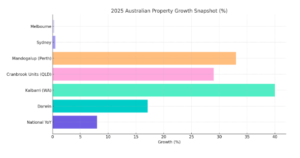
  • Mid-size capitals: Perth, Brisbane and Darwin saw the strongest growth (Darwin +17.1% YTD).

  • Affordable suburbs: Lower-priced markets are booming. For example, Kalbarri (WA) house values are up +40% and Cranbrook (QLD) units +29%. Fringe Perth areas like Mandogalup jumped ~33%.

  • Avoid Sydney/Melbourne hotspots: Sydney (+0.5%) and Melbourne (+0.3%) are near an affordability ceiling. Buyers and investors should instead target affordable cities and regions for better value and yields.

Investor Hotspots 

  • Rising investor demand: Property investors now account for ~38% of new mortgages, the highest share on record. Many are targeting WA and QLD, where yields are strongest.

  • High yields in mining towns: Resource hubs top the charts. Newman (WA) delivers ~12.6% house yields; South Hedland ~17.8% on units.

  • Strong rent growth: Towns like Pegs Creek (Karratha, WA) saw house rents jump +23.5%, and Rockhampton (QLD) +21.1% for units. Yields above 10% are common in these areas.

Balancing Affordability and Risk

Cotality data show the median house price is now ~8.2× average income, and about 45% of median income is needed to service a new loan. These record price-to-income and debt burdens mean many buyers face tight budgets. With rates on hold and strict lending tests (20% DTI cap), borrowing power is squeezed. As buyer’s agents, we focus on each client’s capacity and priorities. We recommend lower-priced, high-yield markets to balance portfolios, and we strongly discourage chasing overpriced Sydney/Melbourne suburbs. Our strategy includes running detailed loan and cash-flow scenarios to match clients with suitable properties and debt structures.

Looking Ahead to 2026

We expect growth to be more measured next year. Listings remain ~18% below normal, but higher inflation expectations and stricter credit will limit demand. Citing Cotality’s outlook, the existing supply/demand imbalance alone won’t deliver 2025-style gains. Instead, smart buyers should pick markets with room to grow – typically entry-level segments with tight supply. Lower-value markets should continue to outperform higher-end markets. In short, it’s about selectivity over speculation– focusing on fundamentals like price, yield and borrowing power, not hype.

Ready to get started? At Buyer Insight, we guide first-time buyers and investors through these changes. We’ll calculate your borrowing power, compare home loan options, and ensure your goals are met. Call us on 0468 444 478 or book a free 30-minute consultation. Follow us on Instagram and LinkedIn for the latest property insights and tips.

How Professionals Build Wealth While Working Full-Time

Between meetings, deadlines and family life, most professionals already juggle more than enough responsibilities. So, the idea of building wealth through property, while working full-time, can feel out of reach.

Yet thousands of Australians are quietly doing it. They’re not flipping homes or chasing risky trends. They’re using a structured approach to build passive income property portfolios that grow in the background while they focus on their careers.

If you’ve ever wondered how they make it happen, here’s the blueprint.

The mindset shift: from income to asset growth

Professionals often think of wealth in terms of salary. But income alone rarely creates long-term freedom. The real shift happens when you move from earning money to owning assets that earn for you.

That’s where property investing for professionals stands out; it leverages your income to secure high-quality assets, and then lets time, rent, and growth do the work.

You don’t need to quit your job or become a developer. You just need to make a few smart, early moves with the right plan behind them.

Why professionals are ideally positioned to invest 

Many professionals don’t realise just how much competitive advantage they already have: 

  • Stable income and borrowing capacity – Lenders love stability, which means leaning on these features will move you forward. 
  • Access to equity – If you are a homeowner, you probably have equity in that property to draw on to fund the next purchase. 
  • Long-term vision – Professionals understand project management, timing, consistency, and risk, all important skills of property investing.

These foundations make it easier to start small and scale sustainably, especially with structured support.

The strategy: smart property investing for professionals

To invest successfully while working full-time, you need a clear framework that can run quietly in the background.

Here’s what that looks like in practice:

1. Build a strong foundation

Start with your finance plan. Get clarity on your borrowing capacity, cash flow comfort, and what kind of property fits your risk profile.
We often work with clients’ brokers and accountants to align their investment structure with broader wealth goals. 

2. Buy investment-grade property

Forget hype. Focus on fundamentals:

  • Locations with population growth, strong job access and infrastructure.

  • Properties with low vacancy, good rental yield and limited new supply.

  • Suburbs where owner-occupier demand underpins long-term value.

That’s the difference between buying a property and buying an investment-grade asset.

3. Let leverage do the heavy lifting

Your income helps you borrow to buy the right property. The rent helps cover the loan.
Over time, capital growth compounds — and as your equity grows, you can reinvest it to build a small portfolio without stretching yourself thin.

4. Treat it like a business, not a side hustle

Set it, monitor it, and review it annually. The goal is to hold well-performing assets for the long term — not to trade constantly.

The secret: passive income property done properly

Passive income doesn’t mean “no effort.” It means structured, low-maintenance growth.

That’s why successful professionals:

  • Use property managers to handle tenants and rent.

  • Set up offset accounts to reduce interest costs.

  • Leverage tax benefits and depreciation wisely (with their accountant).

  • Revisit their equity position every few years to plan the next step.

With the right foundation, one good property can lead to two or three — all quietly working in the background while you continue focusing on your career.

For deeper insights on how to make property work for you, visit our Blog for regular updates on Australian property trends and strategies.

Common mistakes professionals make

We often see capable people delay investing because they:

  • Wait for the “perfect” time. The perfect time rarely arrives — compounding rewards those who start early.

  • Buy emotionally. A great investment isn’t always where you’d live.

  • Ignore holding costs. It’s important to choose properties you can comfortably maintain through market cycles.

  • Try to do everything alone. Delegating the research and negotiation to experts saves time and protects your money.

Each of these can slow down your wealth-building journey — but they’re easy to avoid with guidance and a clear process.

You can see real examples of professionals who overcame these hurdles on our Client Experiences page.

Example: how one professional made property work quietly

A Sydney-based IT consultant in his late 30s came to us with a good income but no investments. He wanted to start building a passive income stream without losing focus on work.

We helped him purchase a townhouse in Brisbane’s middle ring — an area with low vacancy, strong transport links and solid rental yield. The property’s rent now covers most of the mortgage, and capital growth has added over $180,000 in equity in just four years.

He’s since refinanced to buy a second property; both are managed professionally, both compounding quietly while he works full-time.

That’s the power of a simple, data-backed strategy executed well.

The bigger picture: wealth without burnout

Wealth building doesn’t need to mean more stress or more hours. In fact, it’s the opposite — when your money is working for you, your time becomes more flexible.

For professionals, that often means:

  • Building a financial buffer beyond your job income.

  • Gaining freedom to choose projects, reduce hours, or take a career break.

  • Creating options for retirement or early financial independence.

For professionals, the appeal of property investing is that it works alongside your busy schedule. You can continue to be focused on what you know, while your investment works its magic and grows quietly in the background. 

Ready to make your income work harder?

If you’re a professional looking to build wealth without giving up your full-time career, property can be your most reliable path to passive income and long-term freedom.

At Buyer Insight, we specialise in helping professionals buy the right properties with data, discipline and zero hype. Also, feel free to contact us at 0468 444 478, or you can also book a free consultation as well.

So, what are you still thinking about? Let’s turn your income into assets and your career into a foundation for lasting wealth.

Help to Buy Scheme Set to Launch – What Buyers Need to Know

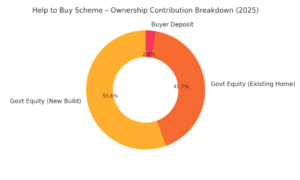
Australia’s long-awaited “Help to Buy” shared-equity scheme opens for applications on 5 December 2025. Under this plan, eligible homebuyers (first-timers and those re-entering the market) can co-purchase a property with the government. Housing Australia will provide up to 30% (for existing homes) or 40% (for new builds) of the purchase price, meaning buyers may need as little as a 2% deposit. The buyer still owns the home, but shares any capital gains or losses with the government. Importantly, the scheme is capped at 10,000 participants per year, so competition for spots will be intense.

Source 

Scheme details and limits

Eligible buyers must be Australian citizens earning up to $100,000 (single) or $160,000 (couples/single parents) annually. Properties must meet price caps that vary by location. For example, Sydney buyers can access homes up to $1.3 million, Melbourne up to $950,000, Brisbane/Gold Coast $1 million, Adelaide $900,000, Perth $850,000, Hobart $700,000 and Darwin $600,000abc.net.au. Eligible properties include new or established houses, townhouses, units or duplexes, and even vacant land with a signed building contract. Buyers must have “reasonable” savings, but can have a deposit as low as 2%. The scheme cannot be combined with other government home-buying guarantees or loans, but can be stacked with stamp duty concessions and the First Home Super Saver scheme.

  • Low deposit: just 2% minimum requiredtheguardian.com.

  • Government stake: up to 40% of a new build, 30% of an existing home.

  • Income caps: $100k (single), $160k (joint).

  • Price caps: city-dependent (e.g. Sydney $1.3m, Melbourne $0.95m).

  • Places: only 10,000 spots per year, nationwide.

Shifts in Demand and Markets

With deposit barriers lower, we expect a shift in first-home-buyer (FHB) demand from apartments to houses. Detached homes in affordable growth corridors will be especially sought-after. As buyers’ agents, we’re watching outer suburbs and regional areas where prices sit under the caps – these could become new hotspots. For instance, families may look further out: suburbs in northwest Sydney, outer Melbourne or regional Queensland where median house prices fit the limits. However, demand will far exceed supply. Research shows roughly 485,000 households could qualify, but only 10,000 places exist. In plain terms, many people will miss out despite qualifying. Buyers must act fast when spots open on 5 Dec.

How a buyer’s agent can help

This is where a professional buyer’s agent brings real value. We will crunch the numbers and research the market to find homes that fit the scheme’s criteria and offer genuine value. Rather than relying on an agent’s guide price, we use recent sales and growth trends to set bids or offers. In many cases, we can even negotiate an off-market deal or submit an offer before auction to secure a property below its maximum value. This keeps our clients out of emotional auction battles. With only 90 days to find a home once approved, our team works quickly: we get buyers pre-approved with one of the initial lenders (CBA or Bank Australia) and then hunt for suitable homes. By aiming for a direct negotiation or carefully timed auction bid, we save our clients time, stress and potentially thousands of dollars in overbidding.

Ready to get started? At Buyer Insight, we guide both first-home buyers and investors through these changes. We’ll help you understand the Help to Buy rules, calculate what you can afford, and negotiate the best deal. Contact our team today to see how the scheme can work for you. Call us at 0468 444 478 or book a free 30-minute consultation.

Follow us on LinkedIn and Instagram for expert property insights, market trends, and real success stories of long-term growth achieved through smart buying strategies!

Inflation Surge: What Buyers Need to Know in a High-Rate Market

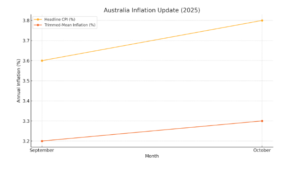
Recent data shows Australia’s inflation has ticked up again – annual CPI hit 3.8% in October (up from 3.6% in September). The Reserve Bank’s preferred trimmed-mean measure of underlying inflation also rose to about 3.3%. Rising housing costs (led by a 37% jump in power bills) were the main driver. In plain terms, price pressures have re-emerged, which means the RBA is now unlikely to cut rates anytime soon – in fact, some analysts say the new inflation data has “devastated hopes” for near-term rate cuts.

Source

The bottom line for property buyers: high interest rates are here to stay (or may even go higher). Borrowing costs remain elevated, and in a globally uncertain economy, there is no guarantee that rates will drop soon. This makes it more important than ever to buy carefully and think long-term. A sound strategy is key; don’t just buy for the sake of it.


Buyers’ Checklist in a High-Rate Environment

  • Stress-test your budget – Assume rates stay at current levels (or higher) when you calculate how much home loan you can afford. Factor in higher repayments and a buffer for future increases.

  • Focus on quality fundamentals – Target properties with strong, long-term appeal (good location, solid rental demand, established neighbourhood). Quality assets are more likely to hold value even if the market cools.

  • Do your homework well — It is very important for you to research the suburb and the property really well. Look at nearby schools, shops, new projects and job opportunities. Properties in growing areas or places with steady demand usually cope better when rates are high.

  • Plan for the long term – Look ahead 5–10 years. Avoid speculation or “flipping” in a shaky market. Choose a home or investment that meets your goals (e.g. home for your family, or a rental that attracts tenants even when borrowing costs are high).

  • Be cautious with timing and price – Don’t rush due to fear of missing out. Interest-rate risk means extra caution on bidding. Stick to a clear strategy and avoid overpaying. 

Maintaining discipline now is crucial. In these conditions, buyers with a long-term view and a focus on quality will be best positioned. As one recent report notes, inflation’s uptick “confirmed a sharp upswing in broader price pressures”, so it pays to build in extra caution.

Plan for the Long Haul

Remember that a stable property investment isn’t just about today’s prices; it’s about sustained value over years of market ups and downs. Quality often trumps quantity: a smaller, well-located home or apartment can outperform a larger, less desirable one in tough times. By contrast, poor-quality or highly leveraged purchases can become a financial strain if interest rates remain high.

In short, don’t buy just to buy – buy with purpose. Set clear criteria (budget, type of home, location, rental potential) and stick to them. If you have doubts, it might be better to wait or save more, rather than stretch too thin. The goal is a property that supports your goals through all seasons of the market.

How Buyer Insight Can Help

At Buyer Insight, our buyer agents guide both first-home buyers and investors through exactly these challenges. We’ll help you: analyse how higher rates affect your budget, hone in on suburbs and properties with strong fundamentals, and negotiate on your behalf. With our support, you’ll have a clear buying strategy, not wishful thinking, to secure a quality asset that can endure a high-rate climate. So, what are you waiting for? Call us on 0468 444 478 or book a free 30-minute consultation. We’ll look at your situation, explain your options, and help you move forward with confidence in today’s market.

Australia’s Spring Market: Where Buyers Can Win Despite Tight Supply

Spring’s arrival brings mixed news for home seekers. Major cities like Sydney and Melbourne remain tight on stock, making these markets competitive. In Sydney, for example, listings have actually climbed year-on-year, which has eased prices and given buyers more negotiating power. By contrast, some regional markets have far fewer homes on offer than a year ago, so any new listing there can trigger a bidding rush. As buyer’s agents, we advise watching market supply closely: if a suburb’s inventory is rising, it can be a strong negotiating chance, whereas low-stock pockets (often outer suburbs) will see stiff competition.

Source 

  • Tight Supply Means Competition. Cities with known shortages become “sellers’ markets.” Buyers should act fast in these areas. We’ve seen Sydney become more of a buyers’ market thanks to rising listings, but this trend can reverse. In places like Adelaide and Brisbane, stock is still limited, meaning buyers need savvy strategies (and a bit of luck) to stand out. 
  • Rising Listings = Leverage. In suburbs where listings are up (for example, parts of inner Sydney), buyers often can negotiate harder and even secure price reductions. Keep an eye out for these pockets – they may not be glamorous, but they offer room to bargain. 
  • Investor Activity Hotspots. Investor demand is rebounding in many states. Brisbane is a prime example: major infrastructure and the 2032 Olympics boom sent Brisbane prices up ~50% in recent years. 

Avoid Oversupply Traps: Not all opportunities are equal. Some inner-city suburbs, especially in Melbourne, are now oversupplied with apartments and older homes. These “danger zones” have seen price drops as supply swamps demand. We recommend clients stick to quality stock: boutique, well-built apartment blocks or established dwellings in stable locations tend to hold value better. In practice, that means avoiding new high-rise towers in CBD fringes and seeking out proven neighbourhoods.

Timing & Finance Strategies: The late-December period (roughly Dec 13–25) often offers a window of lower competition as many buyers take a break before Christmas. This can be a golden opportunity if you’re ready. Make sure your finances are in order, obtain pre-approval early and set realistic borrowing limits. Lenders can be slower during the holidays, so plan ahead.

  • Opportunities for First-Home Buyers and Investors: First-time homebuyers are progressively preferring to purchase boutique developments or established apartments (good location, nice finishes), and not the raw off-the-plan towers. For yield-driven investors, some affordable micro-apartments in growth corridors are still achieving strong yields, but always run the numbers first. Look for suburbs where investor owners are ready to exit – these can become bargains, as well as outlying areas seeing fresh waves of demand. 
  • Key Takeaways: Pay attention to where listings are tight or rising; that tells you where competition and power lie. Stay clear of known oversupply areas (e.g. inner Melbourne units). Get finance sorted early. Time your purchase (the mid-December lull can help). And focus on quality stock in neighbourhoods backed by long-term demand, not just short-term hype. 

For personalised advice on navigating this spring market, contact Buyer Insight. Call us on 61 468 444 478 or book a free consultation today. We’ll help you find the right opportunity and strategy in Australia’s evolving property market.