

Off-Market Properties Australia Explained: What They Are, How a Buyer’s Agent Finds Them and Why Serious Investors Care

If you’ve been searching realestate.com.au or domains and wondering why the good properties seem to disappear before you get a chance, there’s a reason for that. A significant portion of Australian property never makes it to public listing. It sells quietly, through agent networks and private introductions, before the photos are taken and the listing goes live. This is the off-market segment of the property market, and for serious investors, understanding how it works isn’t optional. At Buyer Insight, off-market access is one of the core reasons our clients consistently secure properties that others simply never see.

What Does Off-Market Actually Mean?

An off-market property is available for sale but hasn’t been publicly advertised on major real estate platforms. No Domain page. No open homes. The vendor has decided, for whatever reason, to sell quietly through their agent’s network rather than running a full public campaign.    

The reasons vary. Some vendors want privacy. Others want to avoid the cost and disruption of a public campaign; a full real estate campaign can cost upwards of $5,000 in some markets. Some are testing the water before committing to a public launch. In other cases, vendors dealing with estates, divorce, or relocations need fast transactions without open homes every weekend. Whatever the reason, the result is the same: the property is available, but only to buyers who are already in the right conversations.

How Much of the Market Is Off-Market?

More than most buyers realise. REBAA (the Real Estate Buyers Agents Association of Australia) estimates that up to 20% of properties sold nationally are sold off-market; that’s approximately 100,000 properties per year. In prestigious Sydney markets, that figure is higher still; industry estimates suggest that up to 40% of prestigious sales occur off-market. With total listings already sitting 18% below their 10-year average nationally, according to Cotality, the gap between what’s publicly visible and what’s actually transacting has never been more relevant to investors.

How a Buyer’s Agent Actually Gets Access

This is the part most people don’t see. A buyer’s agent builds relationships with selling agents over years, not weeks. When a selling agent has a vendor who wants to sell quietly, they don’t post it online. They call the buyer’s agents they trust, whose clients are pre-approved and ready to move. It’s faster, cleaner, and less disruptive for the vendor. That’s the exchange: the selling agent gets a smooth transaction, and the buyer’s agent’s client gets first access before the property goes public or never goes public at all.

At Buyer Insight, Pawan Dhillon’s background in residential construction adds a layer of technical insight during these conversations. When we inspect an off-market property in Sydney, we’re assessing structure, quality, and true value simultaneously, not just price. That combination of access and scrutiny is what makes the difference between finding a good off-market deal and overpaying for one.

 Why Serious Property Investors Prioritise Off-Market

Three reasons, and they compound each other:

  • Less competition. No open homes means no weekend crowds, no emotional bidding, and no auction pressure. You’re negotiating with the vendor directly, often as the only buyer at the table.
  • Better negotiating position. Vendors who choose off-market sales typically value speed and certainty over maximum price. That’s an opportunity for a prepared buyer to negotiate terms, not just price.
  • Access to properties that are never listed publicly. Some of the best investment properties in Sydney and its surrounds never appear on any public platform. If you’re not in the right network, you’ll never know they existed.

This is why off-market property buying has become a non-negotiable part of how disciplined investors approach acquisition in 2026. With listings tight and competition fierce, waiting for a property to appear online puts you at the back of the queue, behind buyer’s agents, their clients, and the agent’s existing contacts.

FAQ: Do off-market properties sell for less than on-market?

Answer: Not necessarily, but the conditions are often more favourable for buyers. Without competing offers and auction pressure, there’s more room to negotiate on price, settlement terms, and conditions. The key is knowing the property’s true value before negotiating, which is exactly what Buyer Insight brings to every off-market acquisition. 

FAQ: Can I find off-market properties without a buyer’s agent?

Answer: Technically, yes, but it requires contacting agents in your target suburbs multiple times a week, building relationships across dozens of offices, and being ready to move immediately. Most buyers don’t have the time or the network. A buyer’s agent has those relationships already built, which is why agents call them first.

How Buyer Insight Sources Off-Market Properties in Sydney and Beyond

Buyer Insight works exclusively for buyers, never vendors. That independence matters because every off-market property we bring to a client has been assessed on its investment fundamentals first. We’re not passing on deals because an agent rang us. We’re passing on deals that actually stack up in location, structure, value, and yield, and that have cleared our due diligence process before we recommend them.

For investors serious about building a property portfolio in Australia, particularly in Sydney’s northwest corridor, including Rouse Hill, Kellyville, and surrounds, off-market access isn’t a bonus. It’s increasingly the difference between finding the right property and settling for whatever happens to be listed this weekend.

Conclusion

The off-market property market in Australia isn’t a secret, but it remains inaccessible to most buyers who don’t have the right access. With public listings tight and competition strong in 2026, the investors who consistently find and secure the best properties aren’t the ones refreshing realestate.com.au every morning. They’re the ones working with a buyer’s agent who already has the calls coming in before anything goes live.

Book a free 15-minute consultation with Buyer Insight. Pawan and the team will walk you through our current off-market pipeline and show you exactly how we source and assess properties before they go public. 

Follow Buyer Insight on Instagram, Facebook, and LinkedIn for weekly off-market property insights, investor guides, and Sydney market updates.

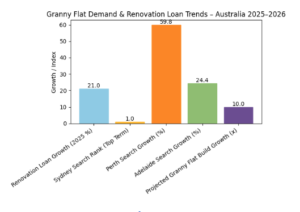
Renovation Loans Jump 21% as Granny Flats Rise Australia 2026

Your Backyard Might Be Your Best Investment Move Right Now

Renovation loans in Australia jumped 21% in 2025. That’s not a small number, and if you look at where a lot of that money is going, granny flats are a big part of the story.

More Australians are waking up to something that smart investors have known for a while: the land you already own could be doing a lot more for you.

Source 

The Numbers Don’t Lie

Searches for “granny flat” are rising fast across property platforms. Sydney saw it become the most searched term, while Perth recorded a 59.8% spike and Adelaide followed close behind at 24.4%. The Housing Industry Association expects granny flat builds to surge tenfold by 2026 compared to four years ago. This isn’t a trend. This is a shift.

Rental demand across the country is still running hot, and dual-living setups are starting to make a lot of sense, not just for big-budget investors, but for anyone who wants to make their property work harder without buying a second one.

What This Means as a Buyer’s Agent

Here’s what clients overlook all the time: they’re focused on finding the next property to buy, when the smartest move might actually be building on what they’ve already got, or buying specifically with this strategy in mind.

A granny flat on the right block can generate consistent rental income, improve your overall yield, and add real value to the land. You’re not just adding square metres. You’re adding options.

A young investor in Newcastle did exactly this. Rather than demolishing and rebuilding, which blew the budget on paper, he kept the front house and built a granny flat in the backyard. Lower build cost, quicker turnaround, strong local rental demand. The numbers stacked up fast.

That’s the kind of thinking we encourage at Buyer Insight. Not just “what can I buy?” but “what can this property do for me long-term?”

What to Look For When You’re Buying

If you’re an investor or even a first-home buyer who wants to offset the mortgage, land selection is more important than ever right now. You need blocks with the right zoning, side access, and sufficient size to allow a secondary dwelling.

This isn’t something you figure out after you buy. It needs to be part of the brief from day one.

Suburbs where granny flat potential exists are quietly outperforming. And with borrowing still tight for many buyers, dual income from one property can be the difference between an investment that grows and one that just sits there.

The decision isn’t always “buy another property.” Sometimes the better call is to get more out of the one you have, or buy the right one with a clear plan to add value down the track.

Worth Knowing Before You Act

Not every block qualifies. Council rules vary. Build costs and timelines matter. And the wrong location won’t deliver the rental return you’re expecting, no matter how well you design the flat.

This is where getting proper guidance early saves you a lot of grief. 

Thinking about a dual-living strategy, or want to know which areas stack up for granny flat potential?

We, at Buyer Insight, help you find the right block and the right strategy. Feel free to call us on 61 468 444 478 and book a free consultation. Follow us on Instagram and LinkedIn for regular market updates and property insights.

Property Due Diligence Checklist 2026: 7 Things Every Investor Must Check Before Buying

The Australian property market in 2026 is moving so quickly that there isn’t much time to think or make mistakes. As of January 2026, home values across the country had gone up 10.2% from the previous year (CoreLogic). Perth’s values increased by 18.5%, and Brisbane’s values increased by 15.7%. The national median home price is now about $957,300 (ABS, December 2025), and homes are selling in a median of 26 days on the market, which is five days faster than a year ago. That speed puts pressure on buyers. And that’s when investors make costly mistakes.

A survey of Australian conveyancers and lawyers found that 26% of homebuyers faced post-purchase problems with the house, which could have been avoided with more thorough due diligence. As independent buyer’s agents for Australian property investors, at Buyer Insight, we constantly see these mistakes. They often include things like failing to check the property’s condition, misunderstanding zoning laws, and misvaluing the property. Before signing anything in 2026, every investor must do all seven of the checks on this property investment checklist.

1. Title Search and Ownership Verification

The first thing to do in any property risk assessment Australia is to verify the legal ownership of the property and identify anything registered against the title. A title search through your state’s land registry, such as NSW Land Registry Services or Landata, Victoria, costs only $15 to $30. It shows who owns the land legally and any mortgages, caveats, easements, or covenants that come with it. Easements need special attention. A drainage easement that goes through the back of a block can prevent approval of a granny flat. A right-of-way across the driveway creates access problems that are costly and time-consuming to resolve. In some cases, it can delay construction and increase development expenses. 

2. Zoning, Planning Overlays and Council Restrictions

Zoning determines what you can and can’t do with a piece of land. In 2026, state governments will be speeding up housing density reforms in Sydney, Melbourne, and Brisbane, so the planning position of any site can change quickly. Check the current zoning type (residential, mixed-use, or rural residential), any limits on height or floor space ratio, and whether there are any overlays for floods, bushfires, or heritage. Also, look at Infrastructure Australia’s published pipeline for big projects near the suburb. A new rail connection can change the rating of a corridor, and a planned arterial road can go through a back boundary.

3. Independent Building and Pest Inspection 

Never rely on the vendor’s inspection report when buying property in Australia. Always arrange an independent building inspection in Australia; get your own from a third party. About one in five pre-purchase inspections finds structural problems, and about one in five homes in higher-risk areas of Australia have damage from timber pests like termites. A qualified building inspector checks the roof void, subfloor, walls, plumbing, drainage, and electrical systems. A separate pest inspection looks for termites, borers, and fungi that cause wood to rot. The total cost is usually between $400 and $900, which is a small amount compared to the cost of fixing structural problems after a settlement.

4. Contract Review, Financial Clauses, and Cooling-Off Rights

Most Australian states give buyers 2 to 5 business days to change their minds after signing a residential contract. However, this protection is not available for auction purchases. In competitive markets, about 25–30% of investor offers also drop the cooling-off period to make their position stronger. Such an arrangement greatly raises the risk if due diligence isn’t done at the exchange. Your lawyer or conveyancer should go over all the terms with you before the exchange. Important clauses include a finance condition that lets you leave if the loan is denied, a building and pest clause, and a due diligence clause that gives you time to check legal, planning, and financial factors. About 8–10% of initial loan applications are being declined due to missing documents or low valuations. This means that a well-written finance clause is always necessary.

5. Strata Report Review Units, Townhouses and Apartments

The strata report gives you a lot of useful information about the building’s finances and maintenance history when you buy a strata-titled property or consider apartment investment in Australia. Ask for the last 2 to 3 years of AGM and EGM minutes, look at the sinking fund balance and the 10-year capital works forecast, and find any special levies that are still due or building problems that haven’t been fixed yet. One of the most obvious warning signs for Australian property investors is an empty sinking fund in an old building. Some strata schemes also have rules about short-term rental platforms and cosmetic renovations. These rules can directly affect your yield strategy, making it harder to get the most rental income and lowering the overall return on investment. Most of the time, strata reports cost between $200 and $400.

6. Environmental and Natural Hazard Assessment Risk

Environmental risk assessment should be an essential part of any property due diligence checklist in Australia, not an afterthought. Check the flood overlay status through the council and state planning portals before signing. If the property is near a hazard zone, check the bushfire attack level (BAL) rating. Also, check the asbestos risk for any building constructed before 1990. In 2026, more insurance companies are leaving high-risk areas or charging landlords and homeowners too much for coverage. In some bushfire-prone coastal and bush areas, insurance is becoming effectively unavailable, and an uninsurable property cannot be financed.

7. Cash Flow Modelling, Yield Analysis and Outstanding Rates

The last check is financial. It has to be based on real numbers, not what the vendor says or the best-case scenario. National rents have gone up 43.9% in the last five years (Cotality, 2025), but in some markets, vacancy rates are beginning to stabilise. Calculate both the gross yield (annual rent divided by purchase price times 100) and the net yield after deducting council rates, water rates, insurance, property management fees (which are usually 8–10% of gross rent), and maintenance. In a high-cost capital city, a property with a 5% gross yield can realistically only give you 3.1–3.4% net. Also, ask your lawyer to check if there are any unpaid council rates, water bills, or utility debts on the property. In some Australian states, these debts become the new owner’s responsibility at settlement. Buyer Insight makes a full cash flow model for each property on our shortlist. We test it under different scenarios, such as vacancy, interest rate, and rental growth. 

Why Smart Investors Work With Buyer Insight

Most investors cut corners and later regret it when they must complete seven rigorous checks within a 26-day settlement window while facing competing bids and pressure from vendors. Buyer Insight was made to solve this exact problem. Our team has years of experience in residential construction and buyer advocacy, which means we can spot problems with building, zoning, and structural risks that other people often miss. We only represent you, not the vendor, so there will be no conflicts of interest.

Buyer Insight does every step of this property due diligence checklist in a planned and repeatable way, rather than as a last-minute rush. This includes finding off-market properties, coordinating building and pest management, helping with contract reviews, and doing full cash flow modelling. Our process is meant to protect your capital and give you complete confidence before you sign anything, whether you’re buying your first investment property or adding to an existing portfolio.

Use this checklist on every acquisition, without exception, and you will consistently avoid buying the wrong property in any market at any price point.

Buyer Insight is ready to work with you if you want a team to handle all of these checks for you in a professional, independent way without any conflicts of interest. We offer a free 15-minute strategy consultation to learn about your goals and show you exactly how our acquisition process works.

On our social media channels, we also share practical tips for investors in real estate, weekly market updates, and data on suburbs. To stay ahead of the market and get updates whenever new property guides, checklists, and investor resources are released, follow Buyer Insight on Instagram, Facebook, and LinkedIn.